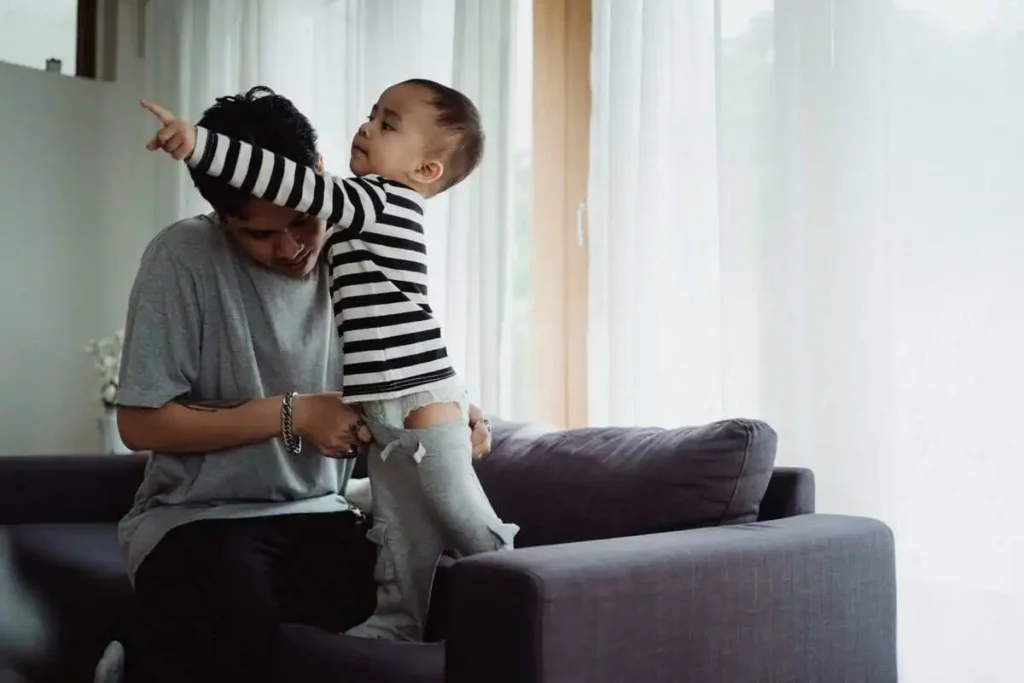
Your 20-month-old points at the window and says, “Uh! Uh!” A crow is sitting on the railing. Your mother-in-law smiles and says, “He’ll talk when he’s ready. His father was the same.” You smile back. But later, scrolling through other children’s videos on the family WhatsApp group, you wonder: is there something I should be doing?
Yes, there is, and the good news is that it costs nothing. You don’t need flashcards, apps or a special class. This guide brings together toddler language development tips from paediatric and speech-therapy bodies in India and abroad, explained in plain words and fitted to Indian homes: busy mornings, grandparents and house help, two or three languages at the dinner table, and a phone that is never far away.
You will learn the one idea that sits behind every good tip, 12 things to try at home this week, what to cut back on, and how to tell when home tips are not enough.
The best way to help your toddler talk is to talk with them, not at them. Get down to their level, notice what they are interested in, name it in simple words, then wait so they can take a turn. Add one word to what they say, read and sing together every day in your home language, and keep screens off during talking time. These habits help every child. But they are not a cure for a delay. If your child is not understanding simple words, not using gestures, has lost words, or you are worried, ask your paediatrician for a hearing check and a developmental screening.
How toddlers learn to talk, and why you matter so much
Toddlers learn language the way they learn most things: from the people who love them, during ordinary moments. Words come from faces, voices and shared attention, not from a screen in the corner.
It also helps to know that talking is only one part of language. Your child understands far more than they can say, and they communicate long before they have words. When parents notice all of this, they worry less and respond better.
| Part of communication | What it means | What it looks like at home |
| Understanding (receptive language) | Making sense of words they hear | Fetches their chappal when you ask; looks at Nani when you say “Where’s Nani?” |
| Talking (expressive language) | Using words to share an idea | “Doodh!” “Papa go.” “More biscuit.” |
| Speech | Making the sounds of words clearly | Says “nana” for banana. Clarity improves slowly. |
| Gestures and sounds | Pointing, waving, nodding, babbling | Points at the crow and says “Uh!”: that is a real message |
The World Health Organization recommends that all infants and children receive responsive care during their first three years, and the Indian Academy of Pediatrics (IAP) describes the stimulation children need as prompt, consistent interaction with “play, talk and love.” In other words, the most powerful tool for language is you.
Related Reading: This article is about how to help. For what most children do at each age, and the signs that need a doctor, see our guide to Developmental Red Flags in Babies and Toddlers (0–3 Years).
The one idea behind every tip: talk with your toddler, not at them
For years, parents were told to simply “talk more” to their babies. Newer research adds an important detail: the back-and-forth matters more than the number of words.
The Center on the Developing Child at Harvard University calls this serve and return. Your child “serves” with a look, a point or a sound. You “return” it by noticing and responding. Then you wait for their next turn. Each little exchange is called a conversational turn.
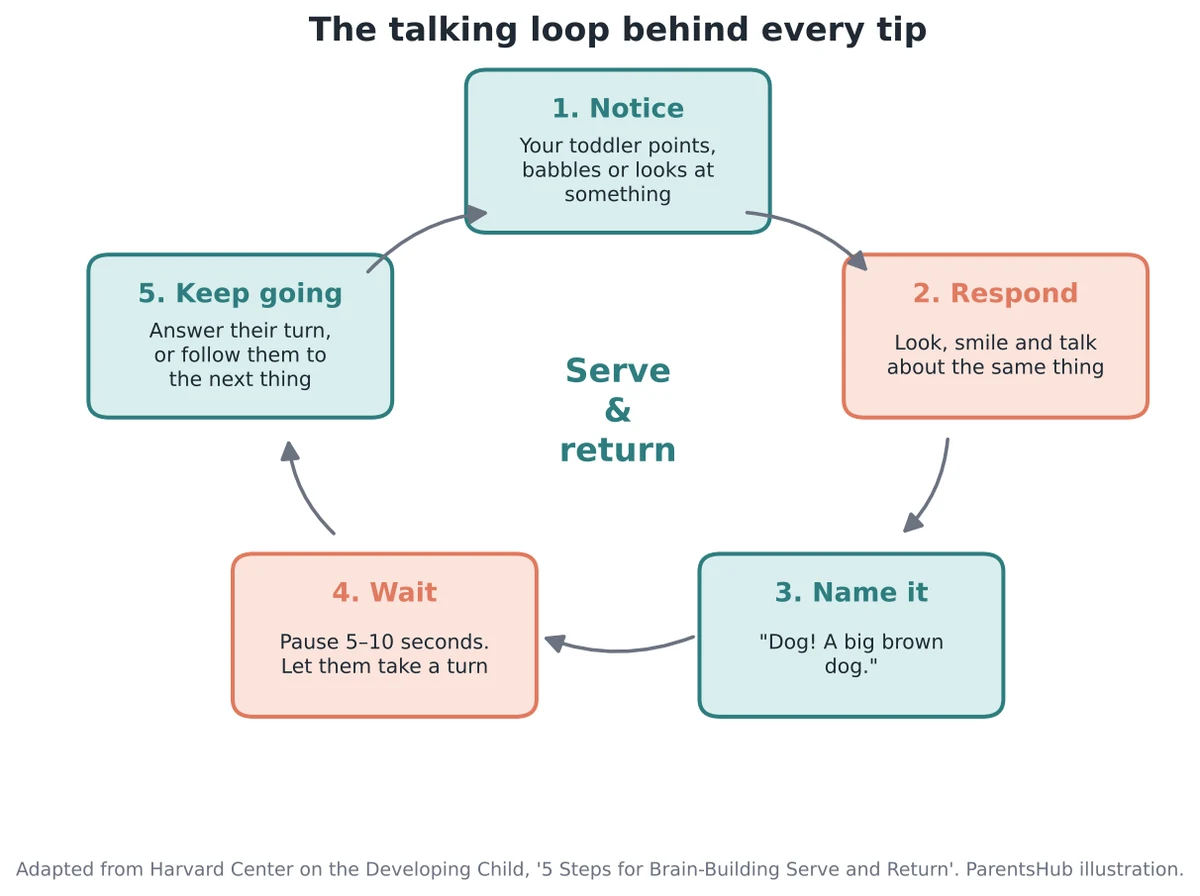
Two studies show why this matters:
- In a US brain-imaging study of children aged 4 to 6, children who had more back-and-forth conversation with adults showed more activity in a language area of the brain, regardless of how many words they simply heard or their family income (Romeo and colleagues, Psychological Science, 2018). It is a small study of older children, so treat it as a clue rather than proof for toddlers.
- In a trial with 71 US families, parents who were coached to use warm, sing-song “parentese” and take turns had babies who took more conversational turns and had stronger language by 18 months (Ferjan Ramírez and colleagues, PNAS, 2020).
“Parentese is a social catalyst for language.”
Dr Patricia Kuhl
Co-director, Institute for Learning & Brain Sciences (I-LABS), University of Washington, USA
Source: Interview with CNN, February 2020 (republished by WRAL)
Closer home, a parenting column from Apollo Hospitals makes a similar point. It describes language as a good measure of the home a child is growing up in, and notes that nuclear families, live-in help and daycare can all cut down the time parents spend talking with their child.
Please take time to talk to your child.
Apollo Hospitals paediatric team · “Talk to your Child” – Apollo Doctors Talk
Source: Apollo Hospitals website · Page updated 2024
12 toddler language development tips you can start today
These tips come from guidance by the US Centers for Disease Control and Prevention (CDC), the American Speech-Language-Hearing Association (ASHA), the UK’s NHS and the Hanen Centre, a speech-therapy training organisation. The examples are ours, set in everyday Indian life. Pick two or three to start with. You do not need to do all 12 at once.
1. Get down to your toddler’s eye level
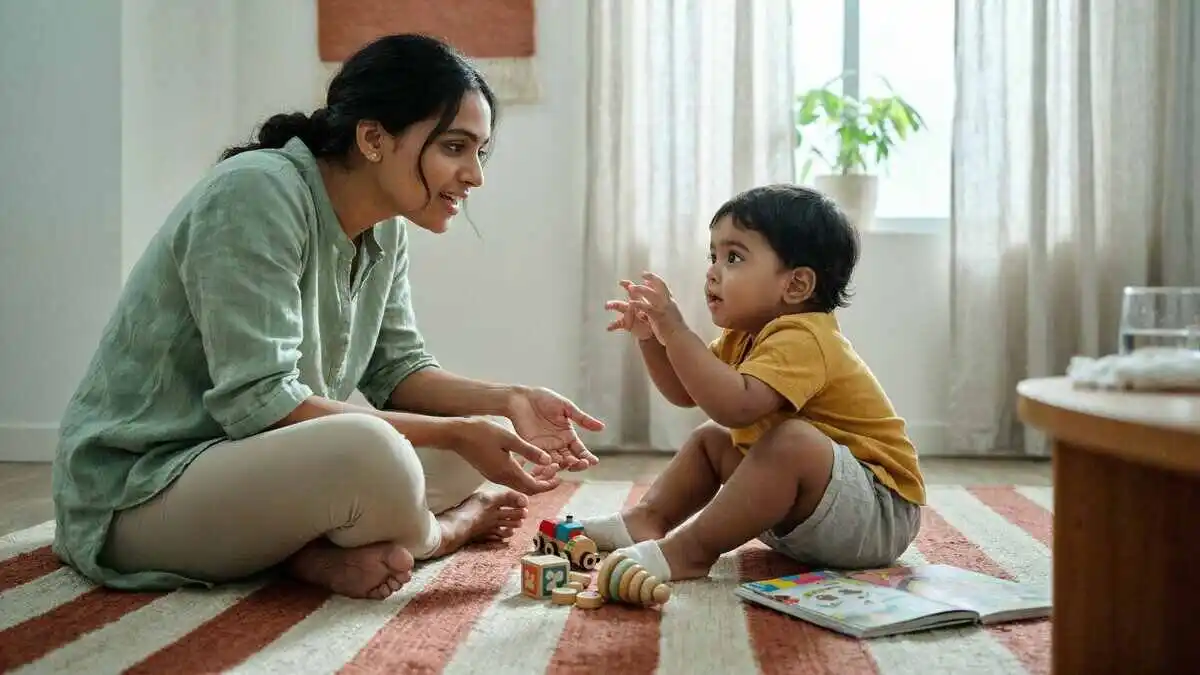
Toddlers learn words by watching your face and mouth. Sit on the floor, crouch next to the high chair, or lie on the mat together. The CDC suggests facing your child at eye level when you talk, so they can see and copy you.
Try this: During playtime, put your phone away and sit cross-legged facing your child. You will be surprised how much more they “talk” when they can see your face.
2. Observe, wait and listen
This is the hardest tip for most parents, because we are used to filling silences. The Hanen Centre calls it OWL: Observe, Wait, Listen. Watch what your child is doing, stop talking, and wait up to about 10 seconds for them to send you a message: a look, a point, a sound or a word.
Try this: Count to five in your head before you say anything. If your toddler holds up a block and looks at you, that is their turn. Now it is yours.
3. Follow your child’s lead
Talk about what your child is already looking at, not what you planned to teach. If you are naming colours on a chart but your toddler is staring at the ceiling fan, talk about the fan: “Fan! Round and round. The fan is going fast.” Hanen notes that children who lead the conversation tend to take more turns, and more turns mean more practice.
4. Narrate your day: say what you and your child are doing
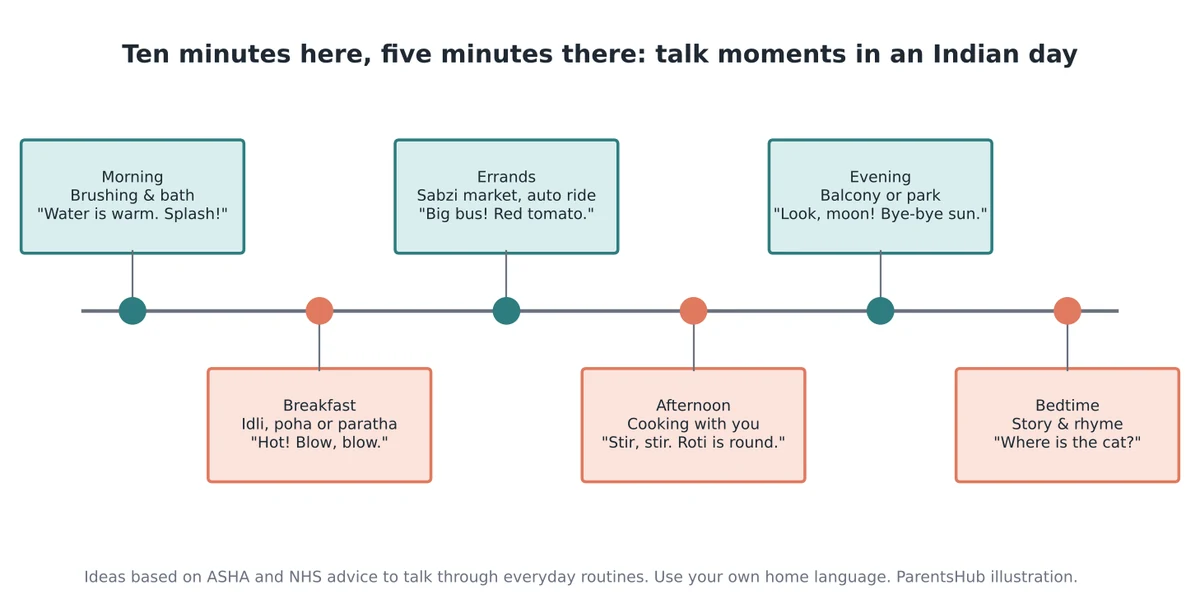
Speech therapists call this self-talk (describing what you are doing) and parallel talk (describing what your child is doing). ASHA and the NHS both suggest talking through everyday routines such as bathing, dressing, meals and shopping.
- Bath time: “Water on your head. Splash! Now soap. Bubbles!”
- Kitchen: “I’m rolling the roti. Round, round. Now it goes on the tawa. Hot!”
- Sabzi market: “Tomatoes. Red tomatoes. Bhaiya is putting them in the bag.”
- Getting dressed: “One arm in. Other arm in. Where is your head? There it is!”
Keep sentences short and repeat key words. A toddler needs to hear a word many times before using it.
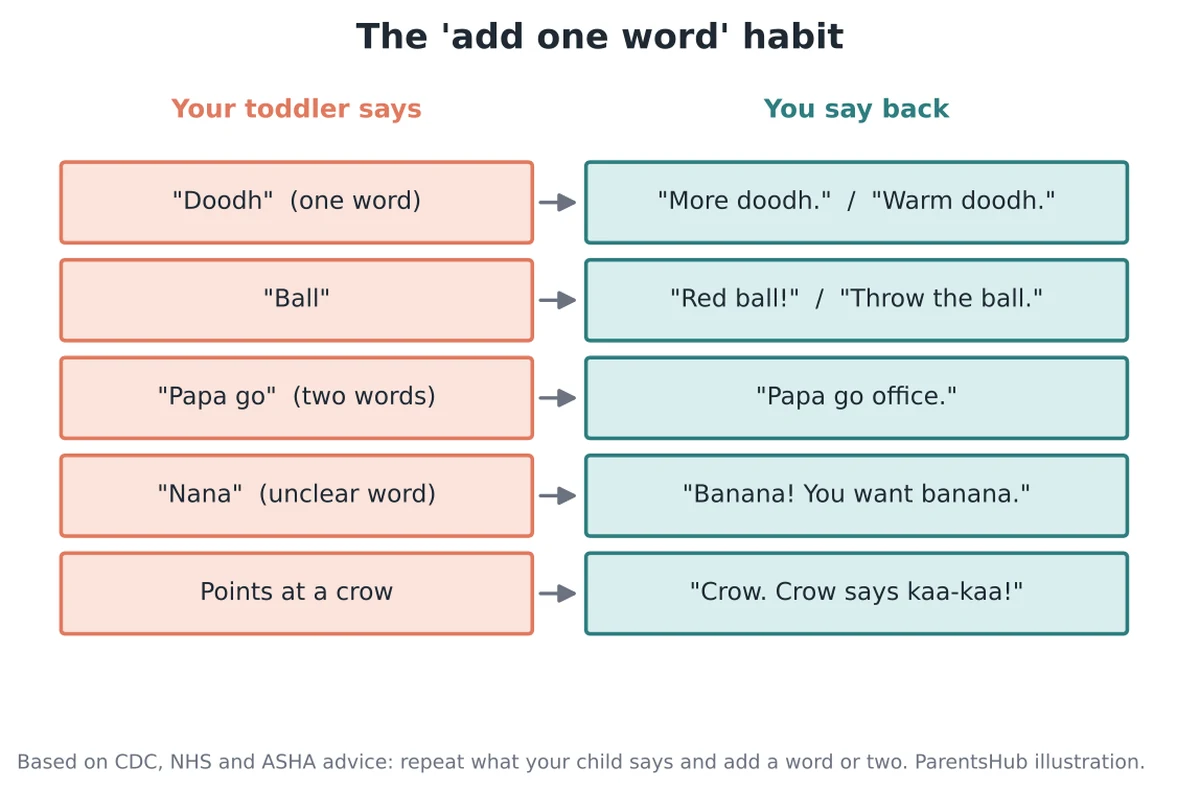
5. Add one word to what your child says
When your toddler says a word, say it back and add a little. The CDC calls this expanding on your child’s words, and the NHS suggests replying with a sentence just a few words longer than your child’s. This shows the next step without any pressure.
6. Say it the right way instead of correcting
If your child says “nana” for banana, don’t say “No, say it properly!” The NHS advises saying the word correctly without criticising, and the CDC gives the example of repeating a child’s words back the right way. Your child hears the correct word, and stays confident.
The same goes for the very Indian habit of asking a toddler to perform: “Say hello to Aunty! Say your name! Say Twinkle Twinkle!” A little is harmless fun. But constant testing can make some children go quiet. Talking should feel like play, not an exam.
7. Offer two choices
Choices give your child a reason to talk and a model of the word they need. Both the CDC and the NHS recommend this.
- “Idli or dosa?”
- “Red cup or blue cup?”
- “Do you want to wear the car T-shirt or the dino T-shirt?”
If they point instead of speaking, that is fine. Say the word for them (“Dosa! You want dosa.”) and hand it over. No need to hold food back until they say it.
8. Comment more, question less
Questions like “What’s this? What colour is it? What does the cow say?” feel like teaching, but they often turn into a quiz. Comments are easier to answer, and they model new words.
| Instead of a quiz… | Try a comment… |
| “What’s this?” | “That’s a cow. Big cow. Moo!” |
| “What colour is the ball?” | “Red ball. It’s rolling away!” |
| “Say ‘car’. Say it!” | “Car. Vroom! The car is going fast.” |
Open questions are still useful with older toddlers (“Where did the cat go?”). Just keep the balance tilted towards comments.
9. Pause and let them fill in the gap
Toddlers love finishing familiar lines. The CDC suggests singing a song and pausing so your child can fill in a word. Try it with a rhyme or a routine your child knows well: “Twinkle, twinkle, little …” and wait. Or “Ready, steady …” before you push the swing. Even a sound or a smile counts as their turn.
10. Read together every day, but don’t just read the words
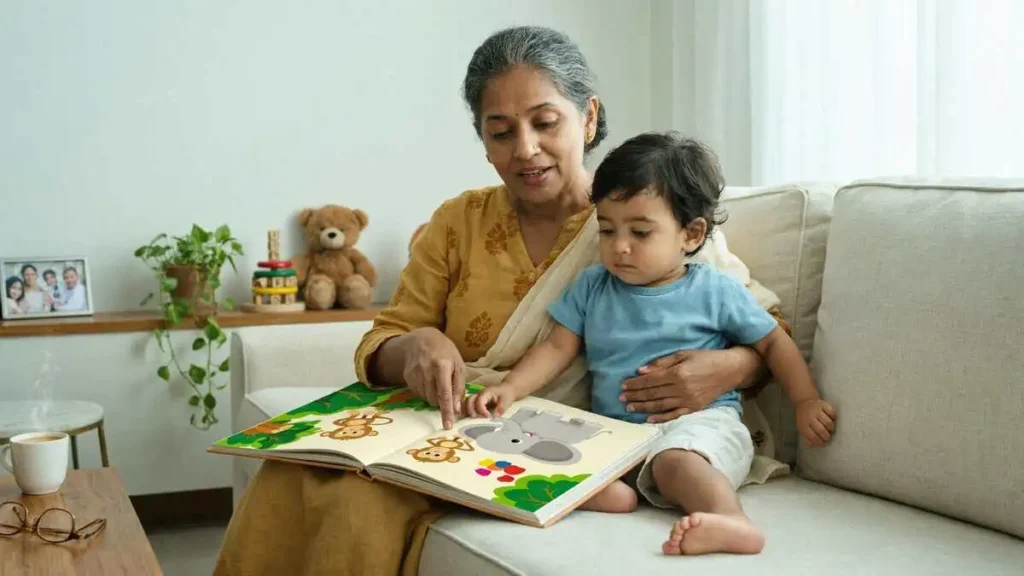
The American Academy of Pediatrics (AAP) encourages reading with children from birth, and the CDC suggests reading with your child and talking about the pictures. With a toddler, you don’t have to finish the book or read every line. Point, name, make animal sounds, and let your child turn the pages. Reading the same book every night is good: repetition is how words stick.
Indian tip: Stories do not have to be in English. StoryWeaver, a free platform from the non-profit Pratham Books, has thousands of illustrated children’s stories in Indian languages. A grandparent telling a story in Tamil or Bhojpuri, with lots of expression, is just as valuable.
11. Sing rhymes and action songs in your home language
Songs slow language down, repeat words and add actions, which makes them perfect for toddlers. The NHS recommends rhymes with actions for this age. Use the songs your family already knows, in whatever language you sing them. Clapping songs, lullabies and festival songs all count.
12. Play pretend, and give your child reasons to communicate
Pretend play gives children something to talk about. A toy kitchen, a doctor set or a few steel bowls and spoons can become a whole conversation: “Cook dal for Papa? Stir, stir. Hot! Blow on it.” Our upcoming guide to toddler language activities will share more ideas.
You can also create small, gentle reasons to talk. Speech therapists often suggest that parents stop guessing every need before the child asks. Put a favourite toy in a clear box they can’t open, or give one biscuit instead of the whole packet. Then wait. When they look at you, point or make a sound, respond warmly and give the word: “Open! You want me to open it.”
REMEMBER Every child talks on their own timeline, and these tips work best when they are fun. If home starts to feel like a speech class, slow down. Five relaxed minutes of real back-and-forth beats half an hour of drilling.
Toddler language tips by age: 12 months to 3 years
The ideas above work at every age, but the focus shifts as your toddler grows. This is a guide to what to try, not a milestone checklist. For milestones by age, see the red flags guide.
| Age | Focus on | Try this at home |
| 12–18 months | Gestures, first words, understanding names of people and things | Name what they point at. Wave and say “bye-bye.” Give choices. Play peek-a-boo and pat-a-cake. Say words correctly without correcting. |
| 18–24 months | Growing number of words; starting to join two words | Add one word to what they say. Name body parts in the bath. Give short, simple instructions (“Bring your shoes”). Read the same picture books often. |
| 2–3 years | Short sentences, questions, longer back-and-forth | Reply with a slightly longer sentence. Talk about what happened earlier (“We saw a dog today!”). Pretend play. Pause in songs. Turn off background TV. |
What can hold back your toddler’s talking
Some everyday habits quietly reduce the back-and-forth that toddlers need. None of these causes a language problem on its own, and none is a reason for guilt. They are simply worth knowing about.
Screens, including background TV
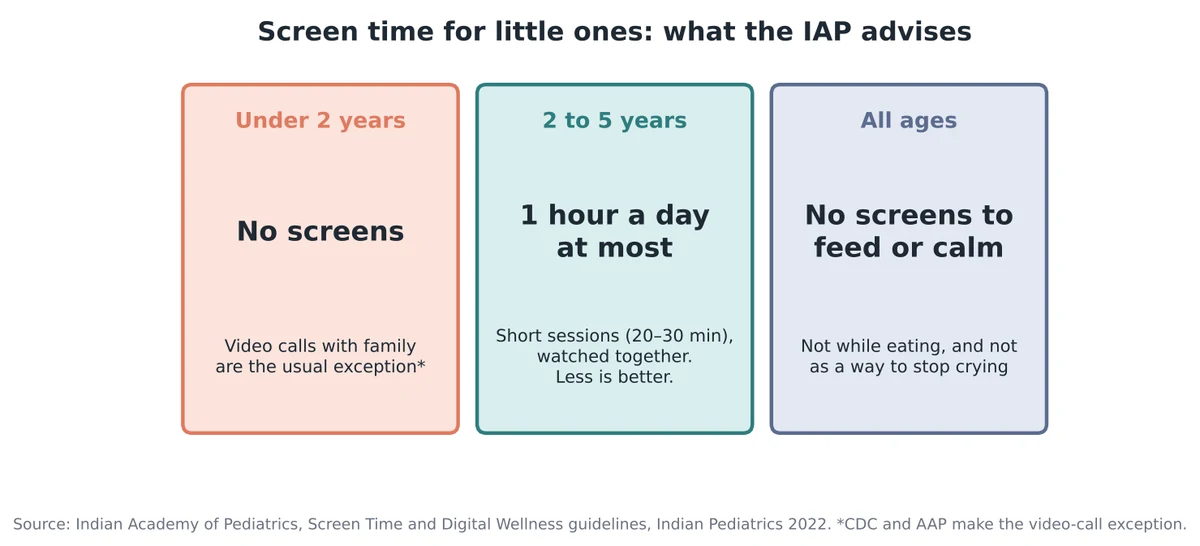
Toddlers learn words from people, not from screens. The IAP’s 2022 guidelines on screen time are clear:
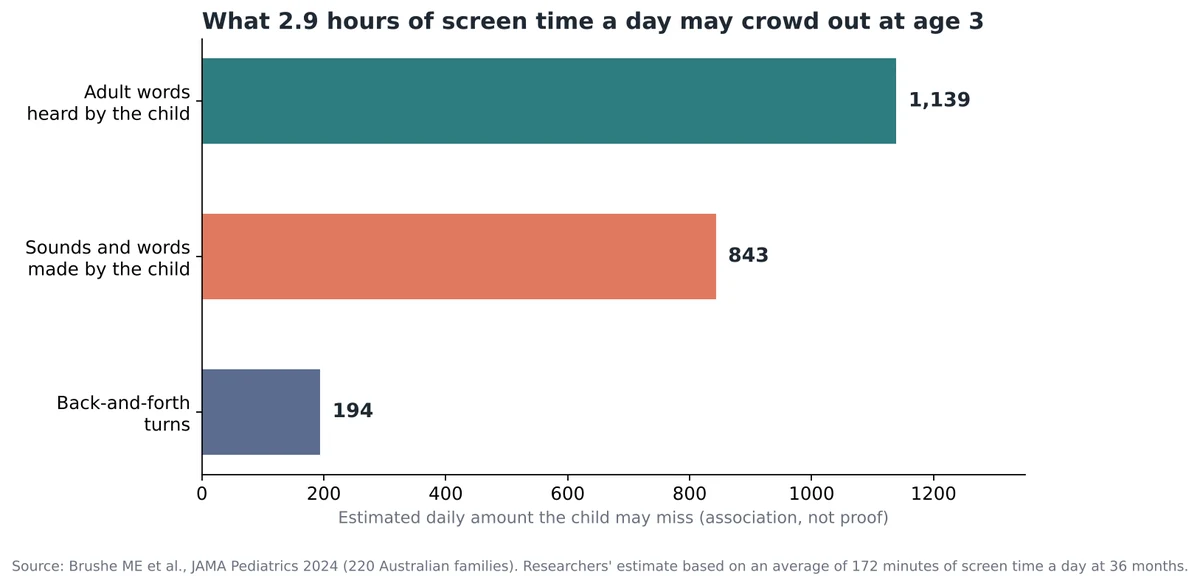
Research suggests why. An Australian study that recorded 220 families at home found that the more screen time toddlers had, the fewer words they heard from adults, the fewer sounds they made, and the fewer back-and-forth turns they took (Brushe and colleagues, JAMA Pediatrics, 2024). At age 3, each extra minute of screen time was linked with about 6.6 fewer adult words.
In India, a study of 718 children under 5 in Tamil Nadu found that 73% had more screen time than recommended, and that higher screen time was strongly linked with language delay (Varadarajan and colleagues, PLoS ONE, 2021). Like most screen-time studies, it shows a link, not proof that screens cause delay. Children who are already struggling may also be given more screen time.
Doctors increasingly put it simply: the problem is less the screen itself and more what it replaces.
💡 Expert Insight
“It’s mostly what the screen replaces, not the screen itself.”
Dr Siddharth Arora
Specialist Pediatrician, Medcare Women and Children Hospital, Dubai
Source: Khaleej Times · 4 September 2026
Practical steps for Indian homes:
- No phone during meals. “Mobile dikhao, khana khilao” is common, but the IAP specifically advises against using screens to feed or calm children. Talk about the food instead.
- Switch off background TV. The NHS notes that background noise from the TV or radio makes it harder for toddlers to listen. A serial playing all evening in the living room counts.
- Video calls with Dadi and Nana are fine. The CDC and AAP make an exception for video chatting, because it is a real two-way conversation.
- If your 2-year-old does watch something, keep it short, watch together and talk about it. Our YouTube Kids guide for parents explains the settings.
- Watch your own phone use too. Toddlers notice when our eyes are on a screen instead of on them.
Dummies (pacifiers) during the day
It is hard to babble and talk with a dummy in the mouth. The NHS suggests offering a dummy only at sleep time and aiming to stop by about 12 months. The research on dummies and speech is mixed, so there is no need to panic. Just keep it out of the mouth during waking, talking hours.
Drilling, flashcards and pressure to learn English early
Many Indian parents feel pressure for their toddler to know the ABCs, colours and English rhymes before nursery admission. The AAP’s parenting site advises against drilling young children on letters, numbers, colours, shapes or words. Instead, it suggests encouraging curiosity and making learning a game. For toddlers, everyday conversation in a language the family speaks well is a stronger base than flashcards.
Pressure can also lead to frustration. Toddlers who can’t yet say what they want often show it through tears and tantrums. Our guide to handling toddler tantrums covers this in its section on toddlers feeling more than they can say.
Encouraging language in an Indian home
Most parenting advice online is written for a small family speaking one language. Indian homes are often different, and that is not a disadvantage.
When your home has two, three or more languages
Your toddler may hear Hindi from grandparents, Marathi from the house help, Tamil from one parent and English from the other. Relatives may warn that this will “confuse” the child. Major speech bodies disagree.
ASHA says most children who learn more than one language say their first words by about age 1 and use two-word phrases by about age 2, and that mixing words from different languages in one sentence is a normal part of learning. The NHS advises talking to your child in whichever language you are most comfortable with.
💡 Expert Insight
“[More than one language] will not delay their speech or language or confuse them.”
American Speech-Language-Hearing Association (ASHA)
Professional body for speech-language pathologists and audiologists, USA
Source: ASHA, Tips for Parents and Caregivers · January 2026
- Speak the language you speak best and most warmly. Rich, natural talk in your mother tongue is better than stiff English.
- It is fine if each parent or grandparent uses a different language with the child.
- When you count your child’s words, count them across all languages together.
- If your child is struggling in every language they hear, that is a reason to talk to your doctor. More languages are not the cause, but a delay still needs checking.
Grandparents, house help and daycare: get everyone on the same page
In many Indian families, a toddler spends large parts of the day with a grandparent, a nanny or a daycare teacher. That is a lot of potential talk time. The trick is to share a few simple habits with everyone, rather than a long list.
Three habits to share with every caregiver:
- Wait for a turn. Pause after you speak, and let the child answer with a word, sound or point.
- Say it right, don’t correct. Repeat the word properly, kindly.
- No phone during meals or play. Talk about the food, the toy, the bird outside.
Grandparents often bring rhymes, stories and endless patience. Use that. And if a relative says “He will talk when he is ready,” you can keep the peace and still act: “You may be right. These games are fun for him anyway.”
For busy working parents
You don’t need long, planned sessions. Research on conversational turns suggests that short, frequent exchanges add up. Use the moments you already have: brushing teeth, the drive or auto ride to daycare, dinner, and bedtime. Ten focused minutes of face-to-face play after work, with your phone in another room, can become the best part of your child’s day.
Is it working? Signs your toddler’s language is growing
Progress is rarely a straight line. Toddlers often go quiet for a few weeks, then suddenly say several new words. Over a month or two, look for signs like these:
- More back-and-forth: your child takes more turns with sounds, gestures or words.
- More pointing, showing and bringing things to you to share.
- Understanding more: following simple requests without your pointing or gestures.
- Trying new words, even if they are unclear.
- Starting to join words together, such as “more doodh” or “Mumma come”.
Keep a simple note on your phone of new words and when you heard them. It helps you notice progress, and it is useful if you ever need to speak to a doctor.
When home tips are not enough
These tips help all children, including those who are slow to talk. But they are not a treatment, and they are not a reason to wait. If something worries you, it is always fine to ask.
Start with hearing. A child who can’t hear well will find it hard to learn words. ASHA notes that ear infections and fluid in the middle ear are common in children under 2, and that hearing loss at a young age can lead to speech and language delays.
💡 Expert Insight
“We first rule out hearing loss among children with problems of delayed speech.”
Dr Sanjay Munjal
Department of ENT, Postgraduate Institute of Medical Education and Research (PGIMER), Chandigarh
Source: The Tribune · 8 April 2024
Speak to your paediatrician soon if your child:
- has lost words or skills they used to have (don’t wait for the next routine visit)
- does not react to sounds or to their name
- is not waving bye-bye by about 12 months, or not pointing to show you things by about 18 months
- is using very few words or not joining two words by about 2 years
- does not seem to understand simple words or requests
- shows little eye contact or interest in people, along with slow talking
For a full, age-by-age list and how to get a screening in India, including free screening through Anganwadi centres under the RBSK programme, read Developmental Red Flags in Babies and Toddlers (0–3 Years).
💡 Expert Insight
“Some children catch up, but persistent delays often continue without help.”
Dr Shiji Chalipat
Consultant Paediatric Neurologist, Ankura Hospital for Women & Children, Pune
Source: Ankura Hospitals blog · 3 June 2026
If your child does need speech therapy, the habits in this article remain useful. Speech therapists usually work with parents and give them activities to use at home, because the hours at home matter far more than the hour in the clinic.
Key takeaways
- Talk with your toddler, not at them.
- Back-and-forth matters more than word count.
- Get down to their level, follow their lead, and wait for their turn.
- Add one word, say words correctly without correcting, offer choices and comment more than you quiz.
- Read, sing and play every day, in the language your family speaks best.
- Keep screens away from meals and talking time. The IAP advises none under 2.
- Home tips help every child, but they are not a reason to wait.
- If you are worried, ask for a hearing check and screening.
Every child finds their voice at their own pace. Your job is not to teach talking like a lesson. It is to make talking worth doing: notice, respond, wait, and enjoy the conversation, even when it is mostly “Uh!” for now.
Free printable: 10 everyday talk habits for toddlers aged 1 to 3.
Print these toddler language development tips and stick them on the fridge, or share them on the family WhatsApp group so every caregiver uses the same habits.
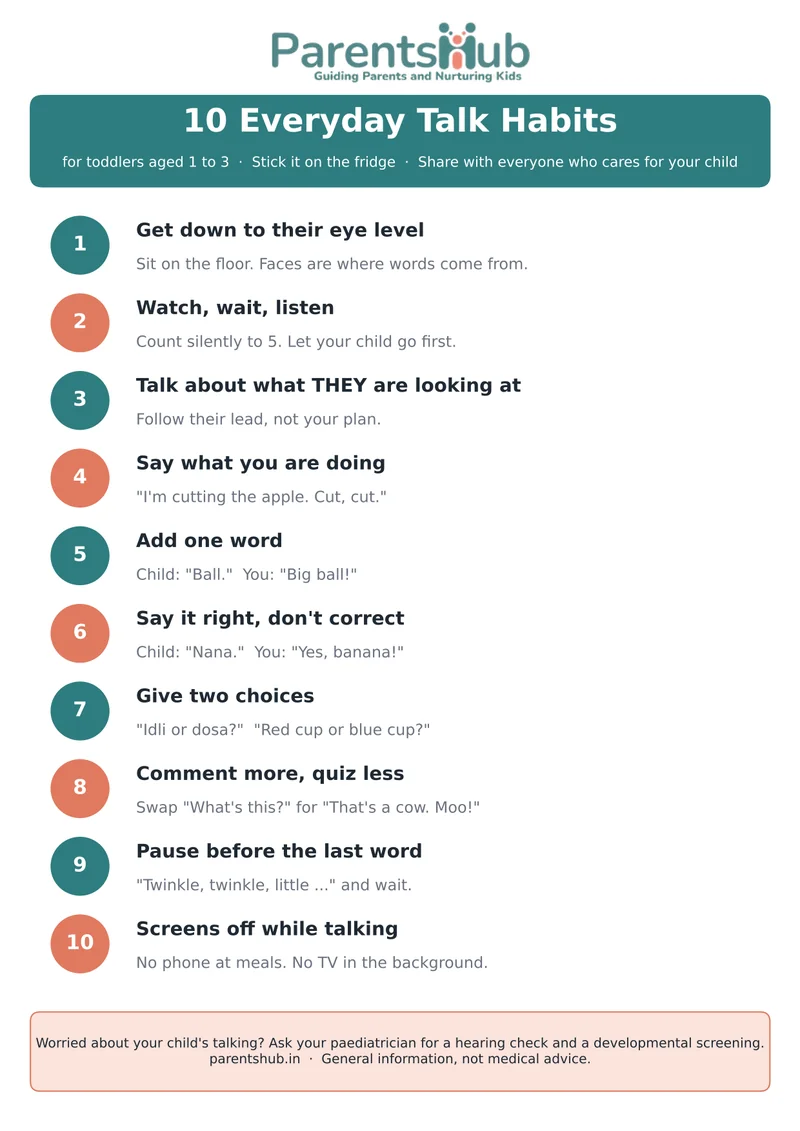
1 page · A4 · Free, no sign-up
Frequently asked questions
How can I help my toddler develop language skills?
Talk with your toddler throughout the day, face to face, about what they are interested in. Respond to every sound, gesture and word, then pause so they can take a turn. Add a word to what they say, read and sing together daily, and limit screens. These everyday habits matter more than any toy or app.
How can I encourage my toddler to talk more at home?
Give them reasons and chances to talk. Offer choices (“milk or water?”), pause before the last word of a familiar rhyme, comment instead of quizzing, and wait longer than feels natural for a reply. Narrate routines such as bath time and cooking so your child hears the same useful words again and again.
How can I improve my toddler’s language skills quickly?
There is no shortcut, and pushing harder usually backfires. What works is frequent, relaxed back-and-forth through the day. Many short exchanges add up faster than one long teaching session. If progress seems very slow, ask your paediatrician rather than trying to speed things up at home.
What activities encourage language development in infants and toddlers?
Everyday routines are the best activities: bath time, meals, dressing and outings. Add picture books, action songs and rhymes, peek-a-boo, and simple pretend play such as cooking or a doctor set. The activity matters less than how you use it: talk about it, wait, and respond.
What are the language skills of a 2-year-old?
According to the CDC, by 2 years most children point to things in a book when asked, say at least two words together (such as “more milk”), point to at least two body parts and use gestures such as nodding or blowing a kiss. Children vary, so see our red flags guide for what to watch.
How many words should a 2–3 year old be saying?
The CDC says that by 30 months most children use about 50 words and join two or more words together. Vocabulary often grows quickly after this. Count words in all the languages your child uses. If your child uses far fewer words, ask for a hearing check and a developmental screening.
Is it normal for a 2-year-old not to speak clearly?
Yes, quite often. Many 2-year-olds are hard for strangers to understand, even if family members follow them. The CDC expects most children to be understood most of the time by about 3 years. Model words clearly without correcting. If even close family can rarely understand your child, mention it to your doctor.
Is it normal for a 2½-year-old not to talk much?
Some quieter children are developing typically, but by 30 months most children use about 50 words and join words together. If your child uses far fewer, don’t wait for the third birthday. Ask your paediatrician for a hearing check and a developmental screening now, and keep using the tips above meanwhile.
When should I worry about my 2-year-old’s speech?
Speak to your doctor if your 2-year-old is not joining two words, uses very few words, does not seem to understand simple requests, does not point or gesture, or has lost words. Losing skills always needs prompt attention. Our red flags guide lists warning signs at every age.
Is it normal for a 3-year-old not to speak?
No. By 3 years most children chat in short sentences and ask simple questions. A 3-year-old who is not speaking, or speaks very little, should see a paediatrician soon for a hearing check and assessment. Early help gives the best chance of progress, so it is worth asking now rather than waiting.
How do I teach my toddler another language? Is 2 years too late?
Two is not too late. Young children pick up languages well through regular, natural use. Have one person or one setting use the new language consistently, such as a grandparent who always speaks Malayalam. Songs, stories and play in that language help. Keep it fun, not a lesson.
Does speaking two or three languages at home cause speech delay?
No. ASHA says learning more than one language does not delay speech or confuse children, and mixing languages is normal. Bilingual children reach early milestones on a similar timeline when you count all their words together. If a child struggles in every language, that needs checking, but the languages are not the cause.
Does screen time cause speech delay?
Studies, including Indian ones, consistently link more screen time with weaker language, but they show an association rather than proof of cause. A likely reason is that screens replace conversation. The IAP advises no screens under 2 and no more than one hour a day from 2 to 5 years.
Are educational videos or apps good for helping toddlers talk?
Not as a substitute for people. Toddlers learn words best from live, two-way interaction. Video calls with family are different because someone responds. If your child over 2 watches something, keep it short, watch together and talk about it. Apps cannot replace a professional assessment if you are worried.
Is baby talk bad for toddlers?
It depends what you mean. Warm, sing-song “parentese” with real words and correct grammar helps children learn. What helps less is replacing words with made-up sounds all the time. So speak with a lively, happy voice, but use the real word: “Look at the big dog!”
At what age do late talkers start talking?
There is no fixed age. Some late talkers catch up by themselves, but others need support, and no one can predict which group a child will fall into just by waiting. That is why doctors recommend a check rather than “wait and see.” Keep using these tips while you get advice.
Can a toddler have a speech delay and not be autistic?
Yes. Speech and language delays have many possible causes, including hearing problems and language disorders, and many late-talking children are not autistic. Autism is about broader patterns of social communication and behaviour. Only a qualified professional can tell after an assessment, so talk to your paediatrician if you are worried.
Should I use flashcards to teach my toddler words?
They are not needed. The AAP advises against drilling young children on letters, colours or words. Toddlers learn words best in real situations: the actual mango, the real dog, the bus going by. If your child enjoys picture cards, use them as a game to talk about, not as a test.
This article provides general information for parents. It is not medical advice and cannot diagnose any condition. Always consult your paediatrician about your child’s health and development.
References
- Centers for Disease Control and Prevention (CDC). Milestones by 18 Months; Milestones by 2 Years. Learn the Signs. Act Early. Updated May 2026.
- American Speech-Language-Hearing Association (ASHA). Activities to Encourage Speech and Language Development.
- ASHA. Learning More Than One Language.
- ASHA. Tips for Parents and Caregivers: Supporting Your Child Who Has a Communication Disorder. January 2026.
- ASHA. Ear Infections (Otitis Media).
- NHS (UK). Help your baby learn to talk. Page last reviewed April 2023.
- Center on the Developing Child, Harvard University. 5 Steps for Brain-Building Serve and Return.
- The Hanen Centre. Waiting: The Key to Supporting Your Child’s Communication. May 2024.
- The Hanen Centre. Children Who Lead Get the Language They Need.
- Gupta P, et al. Indian Academy of Pediatrics Guidelines on Screen Time and Digital Wellness in Infants, Children and Adolescents. Indian Pediatrics. 2022;59:235–244. Read paper (PDF).
- Bharadva K, et al. Consensus Statement of Indian Academy of Pediatrics on Early Childhood Development. Indian Pediatrics. 2020;57:834–841. Read paper.
- World Health Organization. Improving early childhood development: WHO guideline. 2020. Read guideline.
- Romeo RR, et al. Beyond the 30-Million-Word Gap: Children’s Conversational Exposure Is Associated With Language-Related Brain Function. Psychological Science. 2018;29(5):700–710. Read study.
- Ferjan Ramírez N, Lytle SR, Kuhl PK. Parent coaching increases conversational turns and advances infant language development. PNAS. 2020;117(7):3484–3491. Read study.
- Brushe ME, et al. Screen Time and Parent-Child Talk When Children Are Aged 12 to 36 Months. JAMA Pediatrics. 2024;178(4):369–375. Read study.
- Varadarajan S, et al. Prevalence of excessive screen time and its association with developmental delay in children aged under 5 years: A population-based cross-sectional study in India. PLoS ONE. 2021;16(7):e0254102. Read study.
- American Academy of Pediatrics, HealthyChildren.org. Is Your Child Ready to Read? Updated September 2024.
- American Academy of Pediatrics. Early Literacy. Updated April 2026.
- Apollo Hospitals. Talk to your Child (Apollo Doctors Talk). Updated 2024.
- Chalipat S. Is My Child a Late Talker? Parent’s Guide to Speech and Language Delays. Ankura Hospitals, 3 June 2026.
- Mishra N. PGI sees link between screen time, delayed speech. The Tribune, 8 April 2024.
- Khaleej Times. ‘What are screens replacing?’ UAE doctors urge parents to rethink kids’ time online. 4 September 2026.
- University of Washington News. Not just ‘baby talk’: Parentese helps parents, babies make ‘conversation’ and boosts language development. 3 February 2020.
- WRAL / CNN. ‘Parentese’, not traditional baby talk, boosts a baby’s language development. February 2020.
- Pratham Books. About StoryWeaver.