

It’s 2 a.m. Your newborn has been crying for twenty minutes straight. You’ve fed her, changed her, rocked her, sung to her — and she’s still crying. If you’re reading this with a fussy baby in one arm and your phone in the other, take a breath. You are not doing anything wrong. Newborns cry, often for reasons that have nothing to do with anything a parent did or didn’t do. It’s simply how they communicate before they have the first few words.
This guide walks you through how to soothe a crying newborn — the calming techniques backed by pediatric research, what actually works at night and where traditional Indian home remedies genuinely help versus where the evidence says caution. Every technique and claim below is grounded in a cited study or a recognised pediatric source, listed in the References section at the end, so you can trust what you’re reading — and share it with confidence.

Related Read: If you want the full breakdown of every possible cause of infant crying — including illness, teething, stranger anxiety, and noise — see our companion guide, Infant Crying: Causes, Remedies & Parenting Tips. This guide focuses specifically on the how: the structured 5 S’s method, nighttime-specific routines, and Indian home remedies not covered there.
The Fastest Ways to Calm a Crying Newborn
If you need something to try right now, before reading further, here’s how to soothe a crying newborn fast, using a method called the 5 S’s method (explained in full detail below):
- Swaddle your baby snugly in a light cotton cloth, arms tucked in — this limits the reflexive arm-jerking (the Moro reflex) that often startles babies awake or upset.
- Hold her on her side or stomach while she’s awake and in your arms — this position is calming, but always place her on her back for actual sleep.
- Shush firmly near her ear, louder than feels natural — womb noise is roughly as loud as a running shower, so a gentle “shh” often isn’t enough to register.
- Sway or rock her gently in a small, rhythmic motion — steady and repetitive works better than big, unpredictable movements.
- Offer sucking — a feed, a clean finger, or a pacifier if you’ve introduced one; sucking triggers a naturally calming reflex in newborns.
We’ll break down exactly why and how each of these works in the dedicated section below and solve the mystery of how to soothe a crying newborn.
First, Rule Out the Basics
Before jumping into techniques, here’s a fast recap of the usual triggers, each expanded slightly so you know exactly what to check — for the full explainer on every cause including illness, teething, and stranger anxiety, see the companion causes guide linked above.
- Hunger — the single most common trigger in the early weeks. A newborn’s stomach is tiny, so feeds every 2-3 hours are normal. A hunger cry usually starts low and rhythmic, then escalates the longer it’s delayed.
- Overtiredness or overstimulation — counter-intuitively, an overtired baby often cries harder, not softer, because she’s too wound up to settle herself. If she’s been awake, held, or passed around to visitors for more than 45-60 minutes, this is a likely cause.
- Wet or soiled diaper — simple, but easy to miss during a sleepy 3 a.m. change. Always check this first since it’s the fastest fix on the list.
- Need for closeness — newborns spent nine months constantly held and moving. A cry that stops the instant you pick her up, and restarts the moment you set her down, is very often just this — not a sign you’re “spoiling” her.
- Temperature discomfort — check the back of the neck rather than hands or feet, which run naturally cooler. It should feel warm, not sweaty or cold.
- Gas or trapped wind — look for pulled-up knees, a clenched fist, and short, sharp bursts of crying, often during or right after a feed.
Ruled these out and she’s still crying hard? That’s exactly what the rest of this guide is built to help with, starting with the most well-researched calming framework available to parents today.
The 5 S’s Method: A Step-by-Step Guide to Calming Your Newborn
The 5 S’s method was developed by American pediatrician Dr. Harvey Karp and popularised in his 2002 book The Happiest Baby on the Block (Karp, 2002). Karp’s core idea is that babies are born with an innate calming reflex — a neurological “off switch” for crying that can be triggered by recreating the sensory conditions of the womb: constant motion, muffled rhythmic noise, and snug physical containment.
The method has since been taught by trained educators in hospitals, WIC centres, and child-abuse-prevention programs across the United States, and later research has supported its central premise that layering these sensory cues together produces a stronger calming effect than any single technique alone (Happiest Baby, 2023).
It works best for babies from birth to around 3-4 months old, when the startle (Moro) reflex that keeps newborns easily overwhelmed is still strong. Here’s how to do each step properly.
1. Swaddle
Wrap your baby snugly in a light cotton swaddle cloth, with arms gently tucked in. This limits the Moro reflex — the sudden arm-jerk that often wakes or upsets newborns — and recreates the snug containment of the womb. Make sure the swaddle is loose around the hips to allow natural leg movement; hip-tight swaddling is not recommended and has been linked to a higher risk of hip dysplasia in infant orthopaedic literature.
2. Side or Stomach Hold
While your baby is awake and in your arms, holding her on her side or stomach (never on her back) can be calming, since lying flat on the back sometimes triggers a startle reflex in an already-fussy baby. This position is strictly for while you are actively holding her. For actual sleep, always place your baby on her back — the American Academy of Pediatrics’ 2022 safe sleep guidelines are unambiguous that back-sleeping for every sleep, every time, is the single most effective step in reducing the risk of Sudden Infant Death Syndrome (SIDS), and side-sleeping is not considered a safe alternative (AAP, 2022).
3. Shush
This step surprises most new parents — it needs to be genuinely loud. Karp’s research into the womb environment found that constant blood flow and background noise there is roughly as loud as a vacuum cleaner or running shower, so a gentle “shh” often doesn’t register as calming. Try a firm, steady “shhhh” close to your baby’s ear, or use a white noise machine or app at a safe, moderate volume, never blaring.
4. Swing
Gentle, rhythmic motion — swaying side to side, a slow rock, or a short walk while holding your baby — mimics the constant movement she felt in the womb. The motion should be small and rhythmic, not vigorous. Never shake a baby under any circumstances, even out of frustration; always keep movements smooth, slow, and controlled.
5. Suck
Sucking triggers a naturally calming reflex in newborns, which is why babies root and suckle even when they aren’t hungry. Offer a feed, a clean finger, or a pacifier if you’ve already introduced one.
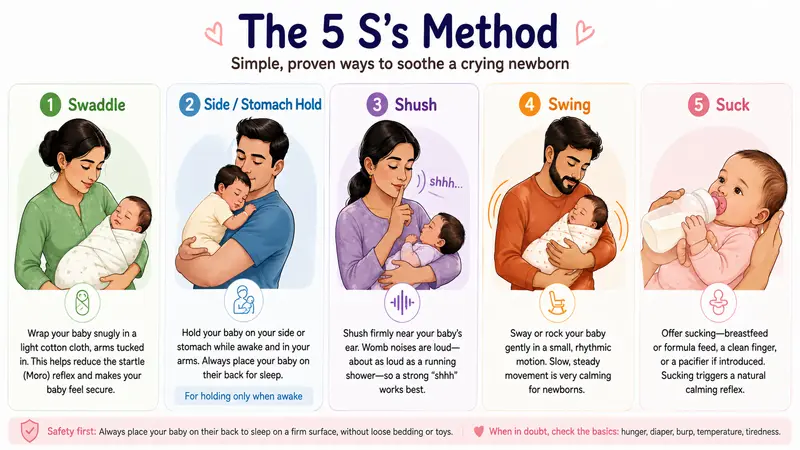
Karp calls combining all five together the “Cuddle Cure” — most parents find that layering 2-3 of the S’s simultaneously (for example, swaddling and shushing and swaying at once) works meaningfully better than trying just one technique in isolation, since it more fully replicates the multi-sensory conditions of the womb rather than a single isolated cue.
How to Soothe a Crying Newborn Without Picking Her Up
Sometimes you genuinely can’t pick your baby up right away — you’re mid-shower, cooking, or simply need both hands free for a moment. It’s a common worry, so here’s what actually helps in those situations, and why each one works even without direct contact:
- Talk or hum from where you are. Your voice alone is deeply familiar and calming, since newborns recognise their parents’ voices from repeated exposure in the womb during the third trimester — you don’t need to be touching her for this to register.
- Use a hands-free bounce or rock. A baby rocker, bouncer, or gently swinging cradle can recreate the rhythmic motion of the “Swing” S without needing continuous holding — just supervise closely and never leave a very young baby unattended in a bouncer.
- Turn on white noise. A steady hum from a fan, air purifier, or white noise app can meaningfully reduce crying within a couple of minutes for many babies, effectively delivering the “Shush” step hands-free.
- Dim the lights and reduce activity around her. Sometimes less stimulation, not more interaction, is what settles a fussy baby — cutting visual and social input can be as calming as active soothing.
- Use a pacifier if you’ve already introduced one, so the sucking reflex stays engaged even while your hands are occupied elsewhere.
None of these fully replace holding your baby when you can — physical closeness genuinely is one of the most effective soothers there is, and remains the fastest single technique for most newborns. But it’s reassuring to know you have real options for the moments you simply can’t hold her.
Common Mistakes That Can Make Crying Worse
New parents often follow their best instincts, and sometimes those instincts unintentionally add to the fussiness. A few worth knowing about, and why they backfire:
Over-stimulating a tired baby. Bouncing, talking, and making eye contact with an already overtired baby can escalate crying rather than calm it, because her nervous system is already past the point of taking in more input. If she’s been awake and “on” for a while, try dimming the lights and reducing stimulation rather than adding more of it.
Switching techniques too quickly. Give each soothing method — swaddling, shushing, swaying — at least a full minute or two before deciding it isn’t working and moving to the next. Karp’s own guidance emphasises that the calming reflex needs a consistent, sustained cue to activate; constant switching can itself feel unsettling and prevents any single technique from taking effect.
Skipping the basics under stress. In the middle of a hard cry, it’s easy to jump straight to complex soothing techniques and forget to check the simple things first — a wet diaper, a missed feed, or a stray hair wrapped around a tiny finger or toe (a surprisingly common and genuinely painful cause of sudden, sharp crying, and worth a quick check before anything else).
Feeling you have to fix it alone. Trying every technique solo for hours, without asking a partner or family member to take over even briefly, tends to raise parental stress, which in turn makes it measurably harder to stay calm and effective at soothing. Tag-teaming isn’t a failure — it’s good practice, and research on parental burnout consistently shows that shared caregiving reduces distress for both parent and baby.
How to Soothe a Crying Newborn at Night
Nighttime crying deserves its own approach, because tired parents and tired babies are a harder combination than daytime fussiness. A newborn is often fussier at night due to a natural buildup of overstimulation from the day, combined with immature circadian rhythms — a newborn’s internal day-night clock, driven by melatonin release, is still developing over the first 2-3 months, which is part of why night and day can feel reversed in the earliest weeks.
A few things that help specifically at night, with the reasoning behind each:
- Keep a consistent, low-stimulation environment. Dim lights, quiet voices, and minimal eye contact during night feeds and changes signal “this is not playtime” to your baby’s developing sense of day versus night, gradually helping her circadian rhythm mature faster.
- Try a wind-down routine before the last feed. A warm (not hot) sponge bath, a short massage, and dim lighting in the same sequence each evening can help your baby’s brain associate that pattern with sleep over time — this is the same principle behind sleep-training routines used later in infancy, just gentler and earlier.
- Use white noise consistently. A steady, low hum placed at a safe distance from the crib can help mask sudden household sounds that might startle a light newborn sleeper awake mid-cycle.
- Rule out the basics first. A wet diaper or a missed feed is far more likely to be the cause at 2 a.m. than anything more complex — check these before reaching for more elaborate soothing.
- Take turns if you have a partner or family member at home. Even a single uninterrupted 3-hour stretch of sleep can meaningfully reduce parental exhaustion, which directly improves your own capacity to stay calm and responsive during the next wake-up.

Is This Much Crying Normal? Understanding Peak Fussiness
New parents almost always ask this at some point: is my baby crying too much?
Here’s the reassuring answer — probably not. Crying tends to build up gradually over the first few weeks, hit its toughest stretch somewhere around the 6-week mark, and then ease off noticeably by 3 to 4 months. This isn’t just something parents notice anecdotally — it’s one of the most well-documented patterns in infant research, first mapped out decades ago and confirmed again and again since in newer studies (Brazelton, 1962).
There’s also a genuinely comforting, India-specific finding worth knowing about. When researchers recently compared crying patterns across 17 countries, babies in India were found to cry less, on average, than babies in the US, UK, or Canada (Vermillet et al., 2022). So if you’ve been comparing notes with a friend abroad and feeling like your baby cries “too much,” the research actually says otherwise.
If you’re in the middle of a particularly hard week, know this: it’s a real, well-recognised phase, not a sign that something is wrong with your baby or your parenting.
What happens if a newborn cries too long, unattended? Occasional short stretches of crying — for example, while you finish washing your hands or attend to another need — aren’t harmful. Newborns don’t need to be picked up within seconds every single time. That said, in the newborn stage, most pediatric guidance recommends responding reasonably promptly, since babies this young haven’t yet developed self-soothing skills, and consistent, responsive caregiving is associated with healthier long-term attachment outcomes in developmental research.
Traditional Indian Approaches: What Helps and What to Be Careful About
Indian families. constituting the grand parents too, have long relied on generations of home remedies and knew how to soothe a crying newborn — and it’s worth talking about these honestly and specifically, with the actual research behind each one, because most global parenting guides skip this conversation entirely.
Gripe Water
Gripe water is widely used across Indian homes for gas and colic-related fussiness — a 2015 cross-sectional study of 335 mothers in Puducherry found that 64.18% were giving their infants gripe water, most believing it aided digestion (Jain et al., 2015).
However, the same study found infants who received gripe water had significantly higher rates of constipation, vomiting, and reported colic compared to infants who did not, with the difference for colic being highly statistically significant (p=0.0001). The exact constipation figures were 19.5% among infants given gripe water versus 5.8% among those who weren’t — a meaningful gap shown in the chart below.
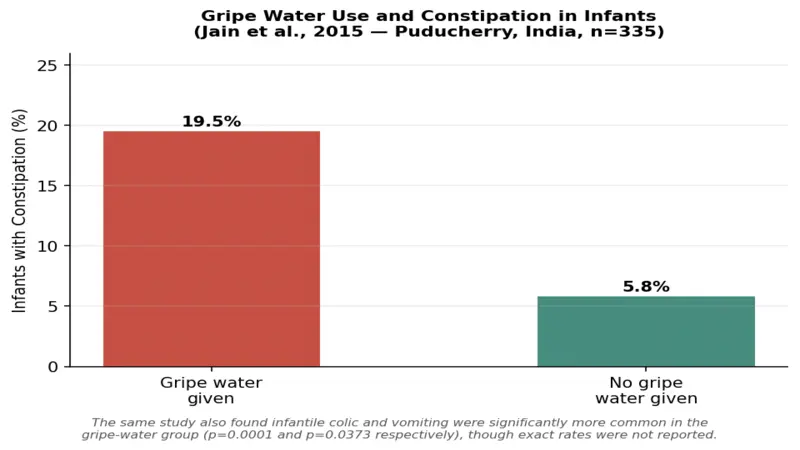
It’s worth being clear about what this means: the study didn’t find that gripe water causes colic — infants may simply be given it more often specifically because they’re already colicky — but it did find no evidence that gripe water prevented or reduced colic, alongside a real association with digestive side effects.
Formulations also vary significantly by brand, with some historically containing alcohol, sugar, or sodium bicarbonate, none of which are recommended for young infants. Always check with your pediatrician before introducing gripe water, especially in the first few weeks, and if used, choose an alcohol-free, sugar-free formulation specifically labelled safe for newborns.
Hing (Asafoetida) and Ajwain Oil Massage
A common practice is a dab of hing paste (mixed with water) applied around, never on, the navel, or a gentle ajwain-infused oil massage on the tummy, believed to ease gas. There isn’t strong clinical trial evidence specifically testing these two remedies, unlike gripe water or oil massage more broadly, but many Indian pediatricians consider them generally low-risk when used externally in small amounts and not ingested. As with any traditional remedy without dedicated trial data behind it, it’s worth discussing with your baby’s doctor first, particularly if your baby has sensitive skin or any existing skin condition.
Oil Massage (Baby Malish)
Unlike gripe water, infant oil massage has a genuinely substantial evidence base behind it — and much of that evidence comes directly from India. A landmark cluster-randomised controlled trial led by researchers at Stanford Medicine, in partnership with Community Empowerment Lab in rural Uttar Pradesh, enrolled more than 26,000 newborns and found that infants massaged with sunflower seed oil showed significantly better weight gain than those receiving usual-care massage, with the largest benefits seen in low-birth-weight infants (Darmstadt et al., 2022).
A separate randomised study published in Indian Pediatrics compared coconut oil, mineral oil, and no-massage groups directly, and found coconut oil massage produced significantly greater weight gain velocity than either mineral oil or no massage at all (Sankaranarayanan et al., 2005).
Beyond the physical growth benefits, oil massage is also widely believed to be calming for many babies — plausibly through the combination of skin-to-skin touch, warmth, and a predictable daily routine, rather than any property of the oil itself. Use a mild, pediatrician-approved oil (sunflower or coconut oil have the strongest evidence behind them specifically; avoid mustard oil, which some research has linked to skin barrier disruption in newborns), keep strokes gentle, and avoid massaging right after a feed.
The Value of Joint-Family Support
One underrated advantage many Indian parents have is a built-in support system — grandparents, aunts, or extended family nearby who can take turns holding a fussy baby, especially during the exhausting evening “witching hour.” If you have this support available, use it without guilt.
Even 20-30 minutes of someone else holding your baby so you can eat, shower, or nap can meaningfully reset your patience for the rest of the day, and shared caregiving is consistently associated with lower parental stress in the research on infant crying and parental burnout. If you don’t have family nearby, consider a trusted friend, a postpartum doula, or simply tag-teaming shifts with your partner. This is how to solve the issue (how to soothe a crying newborn?) for which you have been pondering all these times.

When to See a Doctor: Red Flags You Shouldn’t Ignore
Most crying is normal. But it’s important to know the difference between typical fussiness and signs that need medical attention.
How do you know if your baby is in pain versus just fussy? A pain-related cry is often sudden, sharp, and noticeably different in pitch from your baby’s usual cry, and it may not respond at all to normal soothing techniques like feeding, holding, or swaddling.
Contact your pediatrician promptly if your newborn:
- Has a fever (100.4°F / 38°C or higher in a baby under 3 months is always worth an immediate call, since young infants can deteriorate quickly and are evaluated more cautiously than older babies)
- Cries in a way that sounds distinctly different from her normal cry — unusually high-pitched or weak
- Isn’t feeding well, or is feeding noticeably less than usual
- Has fewer wet diapers than expected (a general guide is at least 6 wet diapers a day after the first week)
- Is vomiting forcefully, or has blood in vomit or stool
- Seems unusually limp, lethargic, or difficult to wake
- Has a swollen or bulging soft spot on the head
- Shows signs of a rash that doesn’t fade when pressed
- Continues crying inconsolably for several hours despite trying all the usual soothing methods, especially if this is a new or worsening pattern
Trust your instincts. You know your baby’s normal cries better than anyone — if something feels different or “off,” it’s always reasonable to call your pediatrician, even just to check.
A Note for Exhausted Parents
If you’ve read this far while rocking a crying baby, here’s something worth hearing clearly: a crying baby is not a sign that you’re failing. The research is unambiguous that newborn crying follows a predictable developmental curve through no fault of the parent, and it eases with time regardless of how “perfectly” any technique is executed. Some nights, nothing on this list will fully work, and that’s not a reflection of your effort or ability.
It’s okay to put your baby down safely in her cot for a few minutes and step into another room to breathe if you feel overwhelmed. It’s okay to ask for help. And it’s okay if some days feel harder than others. This phase is temporary, even when it doesn’t feel that way at 3 a.m.
Frequently Asked Questions
What is the “5 S’s” method, and what age is it for?
The 5 S’s — Swaddle, Side/stomach hold, Shush, Swing, and Suck — is a soothing technique developed by Dr. Harvey Karp, designed to recreate the sensory conditions of the womb (Karp, 2002). It works best from birth to around 3-4 months, when a baby’s startle reflex is strongest.
What does a painful cry sound like compared to a normal cry?
A pain cry is usually sudden in onset, higher-pitched, and more intense than your baby’s typical fussy cry, and often doesn’t ease with the usual soothing techniques.
How much crying is normal, and when does newborn fussiness peak?
Brazelton’s classic 1962 study found crying peaks around 6 weeks at roughly 2.75 hours a day on average, then eases by 3-4 months (Brazelton, 1962). A 2022 cross-country meta-analysis found infants in India tend to cry less on average than infants in the US, UK, or Canada (Vermillet et al., 2022).
Is gripe water safe for newborns, and what should Indian parents know before using it?
A 2015 Indian study found gripe water did not reduce colic and was linked to higher rates of constipation and vomiting (Jain et al., 2015). Formulations vary a lot by brand, and not all are recommended for very young infants. Always check with your pediatrician first.
Can I combine the 5 S’s method with Indian practices like oil massage or gripe water?
Yes — many Indian parents combine both. The 5 S’s are technique-based and safe alongside a gentle oil massage, which has real supporting research from Indian trials (Darmstadt et al., 2022; Sankaranarayanan et al., 2005). Check with your pediatrician before introducing gripe water or any ingested remedy.
How to soothe a crying newborn?
To soothe a crying newborn, first check for basic needs such as hunger, a wet or dirty diaper, being too hot or cold, or needing to burp. Once these needs are addressed, try holding your baby close, gentle rocking, swaddling when appropriate, soft sounds, or offering a pacifier if your baby uses one. Staying calm and responding gently can also help your newborn feel safe and comforted.
How to soothe a crying newborn at night?
To soothe a crying newborn at night, keep the environment quiet, dim, and calm. Check whether your baby is hungry, needs a diaper change, or needs to burp. Hold your baby close, use gentle rocking, and avoid unnecessary stimulation. Keeping nighttime interactions calm can help your newborn settle back to sleep more easily.
How to soothe a crying newborn who won’t stop?
If your newborn continues crying, check for hunger, discomfort, a wet diaper, temperature, or the need to burp. You can also try holding, rocking, swaddling when appropriate, or using gentle sounds. If the crying is unusual or persistent, speak with your baby’s healthcare provider.
Can feeding help soothe a crying newborn?
Yes. Hunger is one of the common reasons newborns cry, so feeding can help soothe a crying newborn. Look for early hunger cues such as rooting, sucking on the hands, or becoming more alert. If your baby has recently fed but continues crying, check for other possible causes of discomfort.
Every baby is different, and what works for one may not work for another — the goal is to build a small toolkit of techniques you can reach for, rather than expecting one method to work every time. If you’re ever genuinely worried about your newborn’s uneasiness and wonder how to soothe a crying newborn, don’t hesitate to reach out to your pediatrician — that’s exactly what they’re there for.
References
- Happiest Baby (Dr. Harvey Karp) – The 5 S’s Method for Soothing Babies
- Pediatrics Journal – Crying in Infancy (Brazelton, 1962)
- Child Development Journal – Crying in the First 12 Months of Life: A Cross-Country Meta-Analysis (Vermillet et al., 2022)
- Journal of Clinical and Diagnostic Research – Gripe Water Administration in Infants: A Cross-Sectional Study (Jain et al., 2015)
- American Journal of Clinical Nutrition / Stanford Medicine – Sunflower Seed Oil Massage Trial for Newborn Growth in Uttar Pradesh (Darmstadt et al., 2022)