Potty training a toddler is one of those parenting milestones that can feel exciting and exhausting at the same time.
You are probably looking forward to saying goodbye to diapers. But then come the questions. Is my toddler ready? Am I starting too early? How often should I take them to the potty? What if they simply refuse to sit on it?
And in Indian families, there can be a few extra challenges. You may have an Indian-style toilet at home. Grandparents or other family members may also be caring for your child. Preschool admission may be getting closer. And, of course, almost everyone around you seems to have an opinion about when a child “should” be potty trained.
The reassuring part is that there is no need to race against the calendar.
Potty training becomes much easier when you watch your child for signs of readiness, choose an approach that works for your family, and stay calm when accidents happen.
In this guide, we’ll go through when to start potty training, the signs that your toddler may be ready, different ways to train, what to do when your child refuses, and how to handle common problems such as accidents and regression. We’ll also look at some situations Indian parents often deal with, including squat toilets, joint-family involvement, preschool, and travelling with a toddler who is still learning.
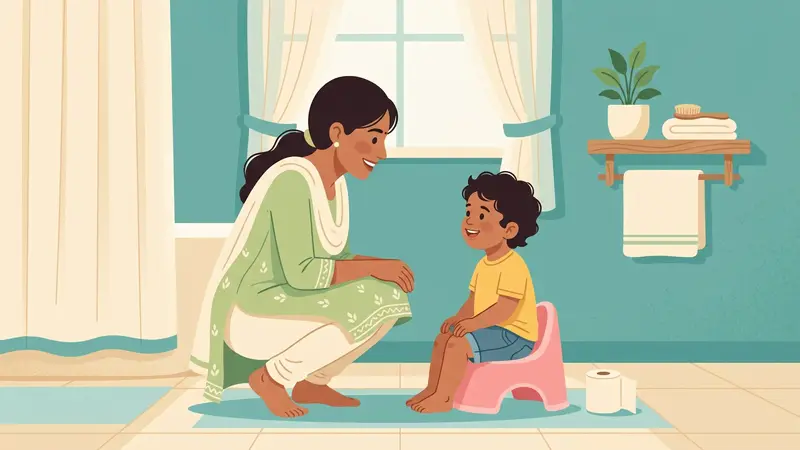
When Should You Start Potty Training a Toddler?
There is no single “right” age to start potty training.
The American Academy of Pediatrics (AAP) discusses toilet training during the 18-month, 2-year and 2½-year well-child visits. Most children begin the process somewhere between the ages of 2 and 3, but the right time depends more on the child’s development than on their exact age.
Indian pediatric guidance follows much the same approach.
Cloudnine Hospitals says potty training can usually begin around age 2, when a child has developed enough bladder and bowel control to hold urine or stool long enough to reach the potty. Staying dry through the night often comes much later and may take another two to four years.
Huggies India also explains that the skills needed for toilet training develop gradually. Children generally gain the physical muscle control needed for training at around 18 months, while full bladder control may develop between ages 3 and 4. Girls, on average, may show readiness a little earlier than boys, although every child develops differently.
Dr Saroja Balan, Consultant Neonatologist and Paediatrician at Indraprastha Apollo Hospital in New Delhi, also advises parents not to focus on a fixed age. Most children are ready at around 2 years, she explains, although some may be ready at 18 months while others may not be ready until closer to 3.
Instead of looking only at age, she suggests watching what your child can already do. A toddler who can follow simple instructions, understands basic toilet-related words, and can stay dry for around two to three hours at a time may be ready to begin.
Research has also shown that starting very early does not necessarily mean finishing earlier. An American Family Physician review noted that the average age at which toilet training begins has gradually shifted from before 18 months to between 21 and 36 months, and starting before 27 months did not provide an added advantage.
So if another child of the same age is already potty trained and yours isn’t, don’t panic.
For most toddlers, signs of readiness matter much more than the date on the calendar.
Common Signs Your Toddler May Be Ready
Instead of watching the calendar too closely, watch your child. Their everyday behaviour can tell you much more about whether it is time to start potty training.
According to HealthyChildren.org, the American Academy of Pediatrics’ parent-focused website, a toddler needs to begin making three important connections: they need to notice the urge to pee or poop, understand what that feeling means, and be able to communicate it in time to reach the potty.
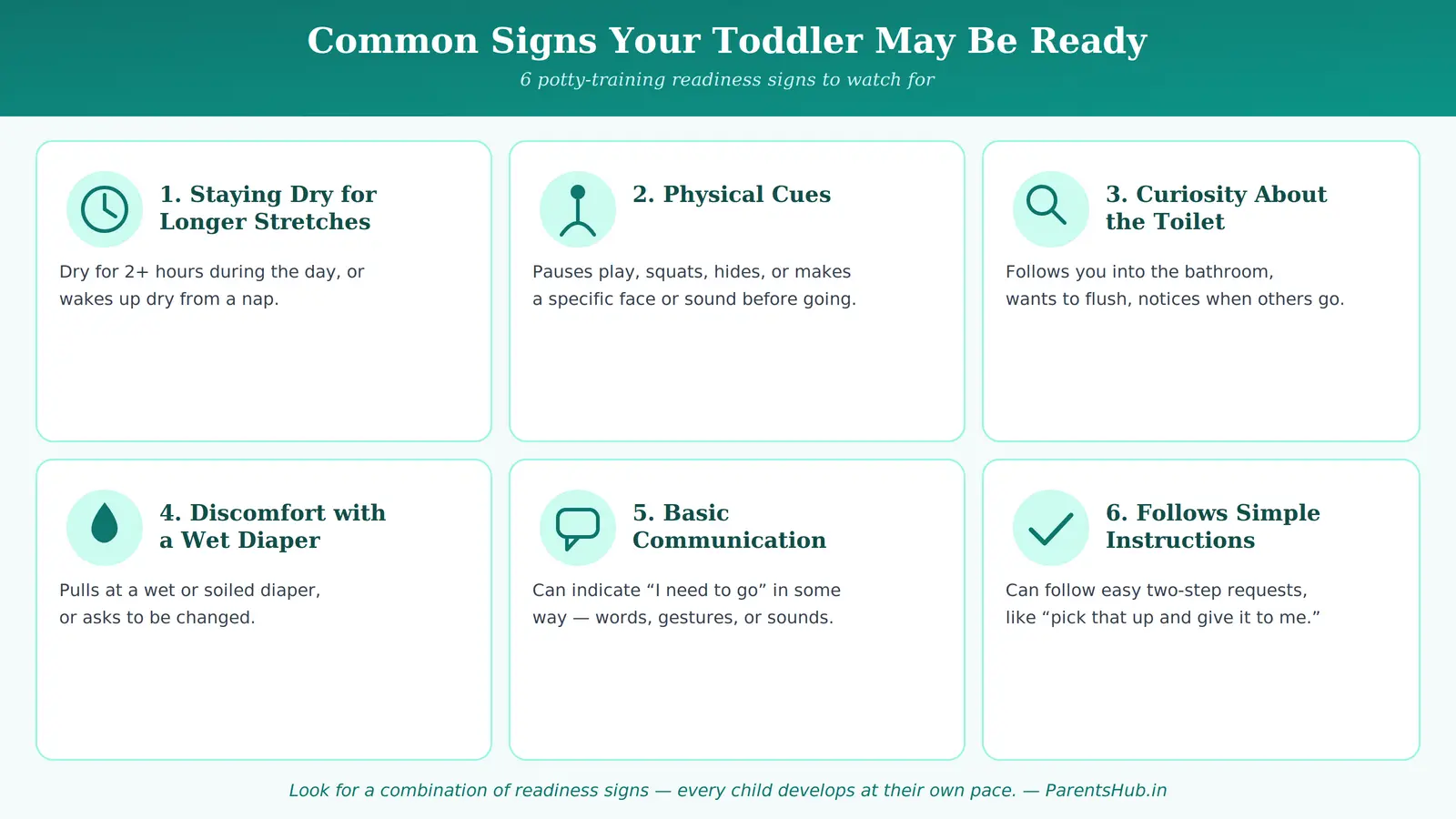
Here are some common signs that your toddler may be ready:
- Stays dry for longer periods: Their diaper remains dry for around two hours during the day, or they sometimes wake up dry after a nap.
- Shows signs before peeing or pooping: Your child may suddenly stop playing, squat, hide in a corner, make a particular face, or become unusually quiet.
- Becomes curious about the toilet: They may follow you into the bathroom, want to watch you flush, or start asking questions about what you are doing.
- Dislikes a wet or dirty diaper: They may pull at it, tell you it is dirty, or ask you to change it.
- Can communicate basic needs: Your toddler can use words, sounds, expressions, or gestures to let you know that they need to go.
- Can follow simple instructions: For example, they can understand and follow a basic two-step request.
There can be some less obvious signs too.
Dr Sahana Shankar, Consultant Pediatrician at Mazumdar Shaw Medical Centre in Bengaluru, suggests noticing whether your child can tell the difference between being dry and wet, changes their facial expression when their nappy is soiled, can sit properly on a seat, and responds to your body language around toilet routines.
She also points out something parents can easily overlook: a bad experience in the bathroom can affect how you are imparting Potty training a toddler. Starting before a child is ready, or even something like a frightening fall in the bathroom, may make a toddler scared of the toilet.
If that happens, pushing harder usually isn’t the answer.
If your toddler is regularly showing several readiness signs, you can gently begin introducing the potty. But if they are frightened, strongly resisting, or simply showing no interest yet, waiting a few weeks and trying again may make the whole process easier for both of you.
Choosing the Right Potty (and What Works for Indian Bathrooms)
The next step is choosing something your toddler can use comfortably.
This sounds simple, but Indian homes can have different bathroom setups. A potty-training method written for a home with only Western-style toilets may not work quite as neatly in a house with Indian-style squat toilets.
Here are the main options:
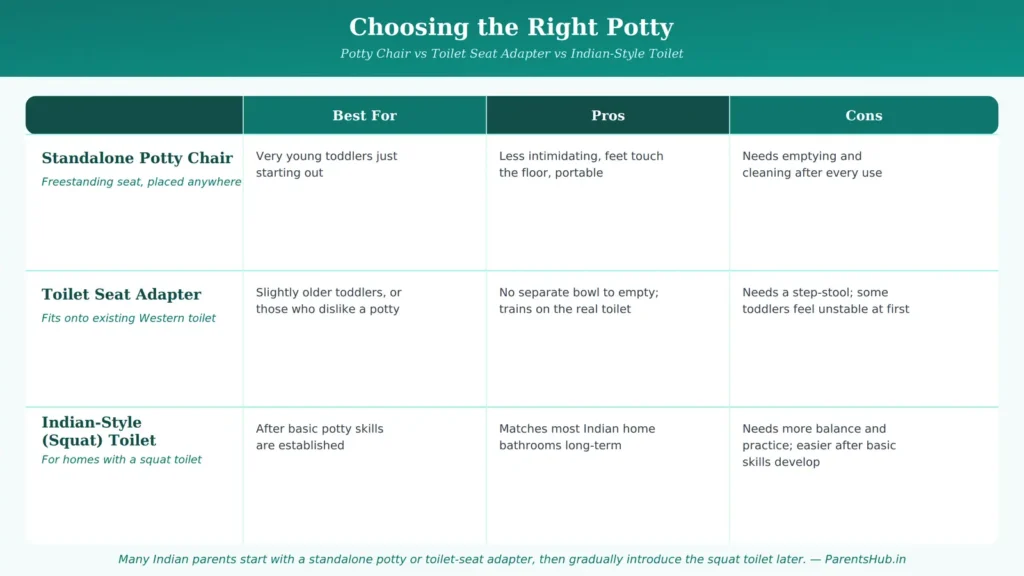
Standalone Potty Chair
This is the small potty chair that sits directly on the floor.
For younger toddlers, it is often the easiest place to begin. Their feet remain firmly on the floor, they can sit down without climbing, and the potty may feel much less intimidating than a full-sized toilet.
You can also keep it somewhere convenient during the early days when you are Potty training a toddler, instead of rushing your child to the bathroom every time.
Toilet Training Seat or Seat Reducer
A toilet training seat fits over your regular Western-style toilet and makes the opening smaller and safer for a toddler.
It works particularly well for children who are comfortable using the family toilet or who have outgrown the standalone potty.
If you choose this option, add a sturdy step stool. A toddler whose feet are dangling in the air may feel unstable and uncomfortable.
While shopping, you may also see names such as infant toilet seat, infant potty training seat, or toilet seat reducer. These products may be marketed under different names, but they serve much the same purpose.
Indian-Style (Squat) Toilet Adapters
This is where potty training can become a little different for Indian families.
You don’t necessarily have to teach your toddler to squat over an Indian-style toilet from day one.
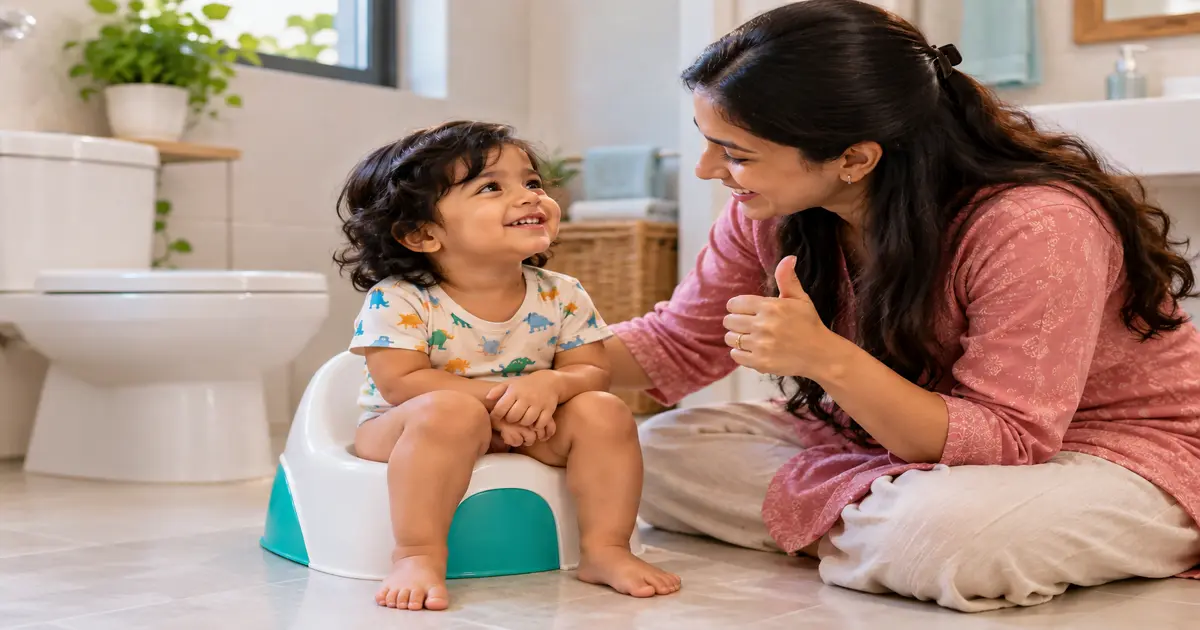
One practical option is to start with a standalone potty chair. Let your child first learn the most important part of potty training: recognising the feeling that they need to go and getting to the potty in time.
Once that habit is established, you can gradually introduce the squatting position and your Indian-style toilet.
Trying to teach bladder and bowel awareness and a completely new squatting technique at the same time may simply make the first few days harder than they need to be.
A Potty Seat for Travel
Potty training doesn’t stop when you leave the house.
Public toilets can be difficult for toddlers, and during travel you may come across both Western and Indian-style toilets. A small foldable or portable potty seat can therefore be very useful while your child is still learning.
Keep it in the car or your travel bag along with wipes, plastic bags and at least one complete change of clothes.
That little preparation can save you a lot of stress when your toddler suddenly announces, “Potty!” at the least convenient possible moment.
Potty Training a Toddler: Step-by-Step Method
There isn’t one “correct” way to potty train every child. Pediatric bodies, including the American Academy of Pediatrics (AAP) and the Canadian Paediatric Society, recommend an approach based on plenty of encouragement and no shame. However, the pace of training can be different for every child.
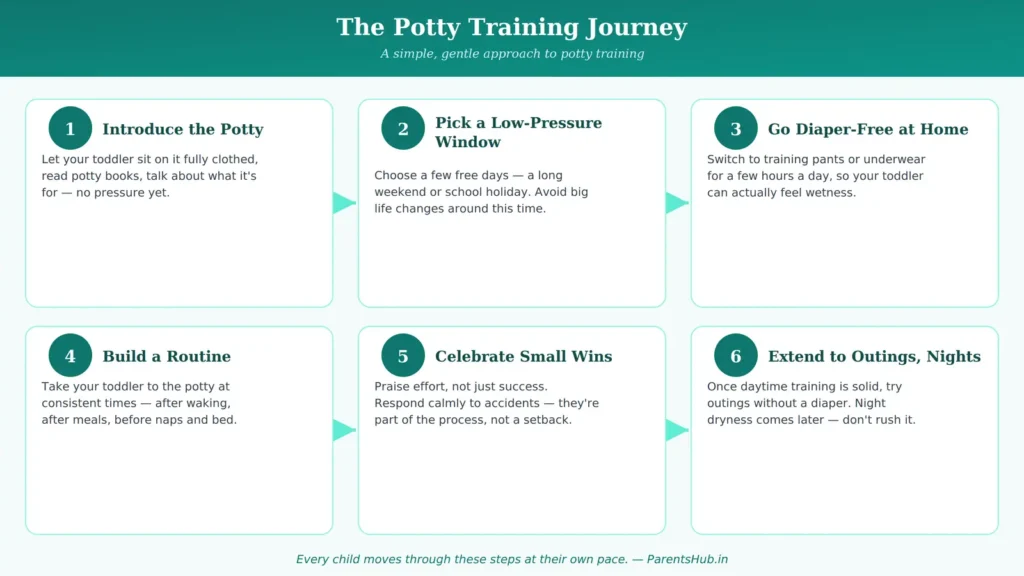
Here is a simple, gentle step-by-step approach that is supported by guidance from several pediatric sources.
Step 1: Introduce the Potty Casually
Start introducing the potty about 1–2 weeks before you actually begin training.
Let your toddler sit on it while fully clothed. You can read potty-themed books together and casually explain what the potty is for.
At this stage, there is no pressure for your child to actually use it. The idea is simply to make the potty feel familiar and comfortable before the real training begins.
Step 2: Pick a Low-Pressure Time to Begin
Choose a time when life at home is relatively calm.
A long weekend, school holidays, or a few days when you don’t have travel plans can work well. This gives you and your toddler enough time to settle into the new routine without constantly rushing somewhere.
Try not to begin potty training during a major change in your toddler’s life, such as the arrival of a new sibling, moving to a new home, or starting daycare.
Toddlers usually cope better when they are dealing with one big change at a time rather than several at once.
Step 3: Go Diaper-Free at Home
Once you begin, switch to training pants or, when practical, let your toddler wear just underwear for a few hours at home.
This allows your child to notice the feeling of being wet immediately. That feeling helps them make the connection between the urge to pee and what happens afterward.
A diaper is designed to absorb wetness and keep your child comfortable, so it can sometimes make that connection harder to notice.
Step 4: Build a Routine
Take your toddler to the potty at regular times during the day rather than waiting for them to ask every time.
Good times to try include:
- after waking up
- after meals
- before naps
- before bedtime
Young toddlers may not reliably tell you that they need to go when potty training first begins. A regular routine gives them plenty of opportunities to practise until recognising and responding to the urge becomes more natural.
Step 5: Celebrate Small Wins, and Don’t Punish Accidents
While Potty training a toddler, do praise your little one for trying, not only for successfully using the potty.
Even sitting on the potty without actually peeing or pooping is a small step forward.
And accidents will happen. They are a normal part of learning, not something your toddler should be scolded or punished for.
Dr Kanchan S Channawar, Senior Pediatrician at Kamineni Hospitals in Hyderabad, specifically advises parents to respond calmly to potty-training accidents and avoid scolding or shaming the child. Instead, gently help your toddler understand what happened and continue reinforcing the potty routine.
Over time, this helps your child learn through repetition and encouragement rather than becoming afraid of getting it wrong.
Step 6: Gradually Move to Outings, Then Night-Time
Once your toddler has been doing well with daytime potty training for a couple of weeks, you can gradually start going out without a diaper.
Keep a spare set of clothes with you because occasional accidents can still happen.
Night-time potty training usually comes later. Staying dry through the night depends more on your child’s physical bladder development than on effort or willpower, so there is no need to rush this stage.
Faster Methods: The 3-Day Method and the “10-10-10” Approach
Some parents prefer a faster and more intensive approach while Potty training a toddler. Two methods that are commonly searched for are the 3-Day Method and the “10-10-10” or “Oh Crap” style approach.
The 3-Day Method
The 3-Day Method is an intensive approach where your toddler stays at home without a diaper for three consecutive days. During this time, a parent or caregiver watches the child closely and takes them to the potty frequently.
This method can work well for toddlers who are already showing strong signs of readiness and are comfortable with a more structured approach.
However, it also requires a parent or caregiver to be available almost full-time for those few days. That may not be practical for every Indian family, especially when both parents are working.
The “10-10-10” or “Oh Crap” Style Approach
The “10-10-10” approach is often associated with intensive methods such as Oh Crap Potty Training. During the focused training period, the toddler is taken to the potty very frequently—roughly every 10–20 minutes.
Training pants are usually skipped during this stage. Instead, the child may remain bare-bottomed or wear clothes without underwear while at home. This allows them to immediately notice what happens when they pee or poop and gradually connect that feeling with using the potty.
Rinie Gupta, host of the Indian parenting podcast The Modern Indian Parent, used this approach with her own daughter. Her experience highlights an important point: consistency matters more than the particular method you choose.
Frequently switching between diapers and no diapers can confuse a toddler and may make the process take longer.
Which Method Should You Choose? If your toddler is showing strong readiness signs and you have a few flexible days at home, an intensive method may help you make faster progress.
But if that kind of schedule doesn’t suit your family—perhaps both parents are working, you have a younger baby to care for, or several family responsibilities—a slower, routine-based approach can work just as well. It simply takes a more gradual path.
Dr Kamlesh P Haria, Consultant Pediatrician at SL Raheja Hospital in Mumbai, offers a useful reminder for parents who are in the middle of the process: your toddler may not get it right immediately. What matters is establishing a consistent pattern and sticking with it until the habit develops.
Potty training is not only about leaving diapers behind. It is also an important step towards greater independence for your child.
Dr Haria also suggests an important checkpoint for parents. If a child is still not toilet-trained by around 3–4 years of age, it is worth discussing this with a pediatrician, as there may sometimes be an underlying behavioural or developmental reason that needs attention.
What to Do When Your Toddler Refuses to Potty Train
Refusal is one of the most common—and often most frustrating—parts of potty training. Your toddler may refuse to sit on the potty, hold in pee or poop, insist on using a diaper, or simply have a tantrum whenever you mention the potty.
Here are some common situations and what may help:
Refusing to Sit on the Potty at All
Don’t force your toddler to sit on the potty.
Instead, go back a step. Let them watch a parent or sibling use the toilet, read potty-themed books together, and keep the potty around without putting pressure on them to use it.
Then try introducing it again after a week or two. Sometimes a little time is all a toddler needs to become more comfortable with the idea.
Holding Pee or Poop
Some toddlers start holding in their urine or stool during potty training. This may happen because they are afraid of the potty, or because mild constipation has made passing stool uncomfortable.
This can sometimes turn into a cycle: pooping hurts, so the child tries not to poop, which can make the problem worse.
This is also the kind of situation parents may be dealing with when they search for things like “toddler holding pee all day” or “toddler hasn’t pooped in 3 days.”
If the problem continues for more than a few days, it is worth speaking to your pediatrician. Diet and hydration may help in some cases, but prolonged stool-holding can become a medical concern rather than simply a potty-training problem.
Only Going in a Diaper
It is quite common for a toddler to pee successfully in the potty but still insist on wearing a diaper when they need to poop.
A gradual approach can help. One commonly used bridge technique is to let your toddler wear the diaper while sitting on the potty and then cut a small hole in the diaper. Once they become comfortable pooping this way, you can gradually work towards removing the diaper completely.
General Resistance or Tantrums Around Potty Time
If every attempt at potty training turns into a battle, your toddler may simply not be ready yet.
Strong resistance, repeated tantrums, or genuine fear can be signs that you started a little before your child was ready.
In this situation, pushing harder may make potty training even more stressful. Pediatric guidance generally supports taking a break for a few weeks and trying again later rather than forcing a frightened or strongly resistant toddler.
Potty Training Regression: When Progress Suddenly Stops
It can be frustrating when a toddler who seemed to be fully potty trained suddenly starts having accidents again. But potty training regression is quite common and, in most cases, completely normal.
Regression can happen for several reasons, including:
- a new sibling arriving
- starting daycare or preschool
- moving to a new home or travelling
- illness, especially a UTI or constipation
- a big emotional change, even one that may seem small to an adult
If the regression is sudden and continues, it is worth checking with your pediatrician to rule out problems such as a urinary tract infection or constipation.
In many cases, potty training regression settles within a few weeks once the stress or change behind it has passed.
During this time, try to respond calmly rather than showing frustration. Go back to the basics for a while—regular potty reminders, a familiar routine, and plenty of encouragement. Treat the accidents as part of the process rather than as a failure.
If the regression continues for more than a month without any clear reason, or your child also has pain, fever, or unusual urination patterns, it is a good idea to speak with your pediatrician.
Nighttime Potty Training: A Different Timeline Entirely
Daytime and nighttime potty training are actually two different things. Pediatric guidance is quite consistent on this: staying dry at night depends largely on your child’s bladder capacity and physical development, not simply on practice or willpower.
That is why nighttime dryness often comes later than daytime potty training—sometimes by a few months and sometimes by a couple of years.
Here are a few practical things to keep in mind:
- Most children are not fully dry at night until somewhere between ages 3 and 5. Some children take longer, and that can still be within the normal range.
- Look for a natural sign of readiness. If your toddler regularly wakes up with a dry diaper after naps or in the morning, it may be a sign that they are becoming ready to try sleeping without one.
- Make nighttime accidents easier to manage. A waterproof mattress protector can save a lot of trouble, and keeping the bathroom easy to reach can help too. A nightlight may be useful if your child needs to get up during the night.
- Don’t worry about occasional bedwetting too early. According to Cleveland Clinic guidance, occasional bedwetting is generally not considered a concern until around age 8. So there is no need to rush this stage or make a young child feel that nighttime accidents are a problem.
Many parents searching for “potty training a toddler at night” are really wondering when they should stop using the nighttime diaper altogether.
Potty Training in Indian Homes: What Global Guides Don’t Tell You
Most potty-training advice online is written for American or European families. But Indian homes can be different—from the type of toilets we use to joint-family living and even our weather.
Here are a few things Indian parents may need to think about.
Squat Toilets
As we discussed earlier, if your home has an Indian-style squat toilet, it may be easier to use a two-stage approach. You can start potty training with a standalone potty seat so your toddler first learns to recognise when they need to pee or poop and use the potty.
Once they are comfortable with that, you can gradually introduce the squatting technique. This can be easier than expecting your toddler to learn potty training and how to use a squat toilet at the same time.
Seasonal Timing
The time of year can make potty training a little easier too. Several Indian parenting resources point out that warmer months can be more convenient because toddlers usually wear lighter clothes that are quicker and easier to remove.
This is a simple but practical point, especially if you are planning potty training around the school year or the monsoon season.
Joint-Family Involvement
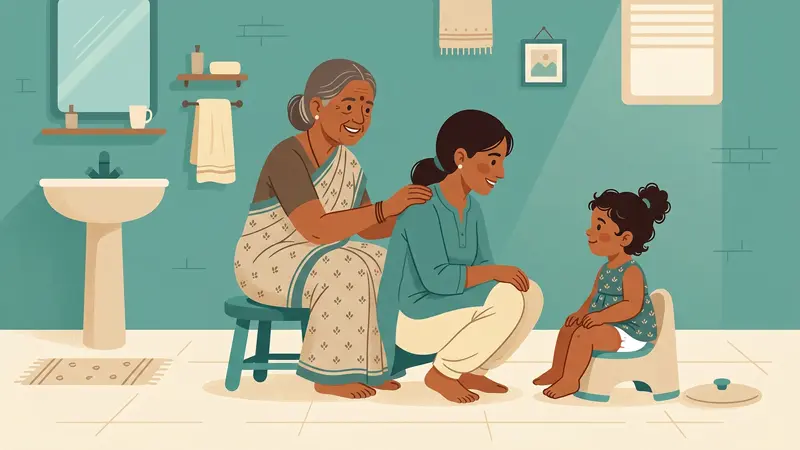
In many Indian homes, grandparents or other family members are closely involved in looking after a toddler. You may also have a nanny or domestic help caring for your child during part of the day.
Before you begin potty training, try to get everyone following the same routine. It also helps if everyone uses the same words and responds to your toddler’s potty cues in a similar way.
Otherwise, your child may receive different instructions from different caregivers, which can make an already new experience more confusing.
Daycare and Preschool Readiness
Some Indian preschools expect children to be at least partly potty trained before admission. This can understandably make parents feel that they are working against a deadline.
If preschool admission is approaching, you can start the early groundwork—such as introducing the potty and helping your toddler become comfortable with it—a few weeks earlier than you otherwise might.
However, your child’s readiness should still guide the actual training process.
Travel and Public Toilets
Long car journeys, holidays, family functions and weddings can all make potty training more challenging.
Public toilets in India also vary widely, and you may encounter both Western-style and squat toilets while you are away from home.
A portable potty seat can be very useful during this stage. It also helps to keep a small “potty kit” ready in the car or your travel bag with spare clothes, wipes and plastic bags.
It is much easier to have these things ready beforehand than to start looking for them when your toddler suddenly needs the toilet.
Special Situations: Speech Delay, Autism, and Other Developmental Differences
If your toddler has a diagnosed or suspected speech delay, autism, or another developmental difference, potty training may take longer and may need a different approach. Some children may benefit from visual schedules, extra repetition, or support from an occupational or speech therapist.
This is an area that most general potty-training guides don’t cover in much detail. So it is worth discussing your child’s individual needs with your pediatrician rather than relying only on general potty-training advice. The right timeline and approach can vary quite a lot from one child to another.
Motivation and Rewards: What Actually Helps
Positive reinforcement is one of the most commonly recommended ways to encourage toddlers during potty training.
Praise, sticker charts, or small rewards for trying—not just succeeding can help keep your toddler interested without making the process feel like pressure.
One simple approach is to use a basic reward chart. Each time your toddler tries to use the potty, they get to add a sticker to the chart, whether or not they actually pee or poop. After collecting a certain number of stickers, they can receive a small, non-food reward.
To make this easier, we’ve put together a free printable potty training chart you can stick on the fridge or bathroom wall — just add a sticker for every try, no pressure, no perfect streaks needed.
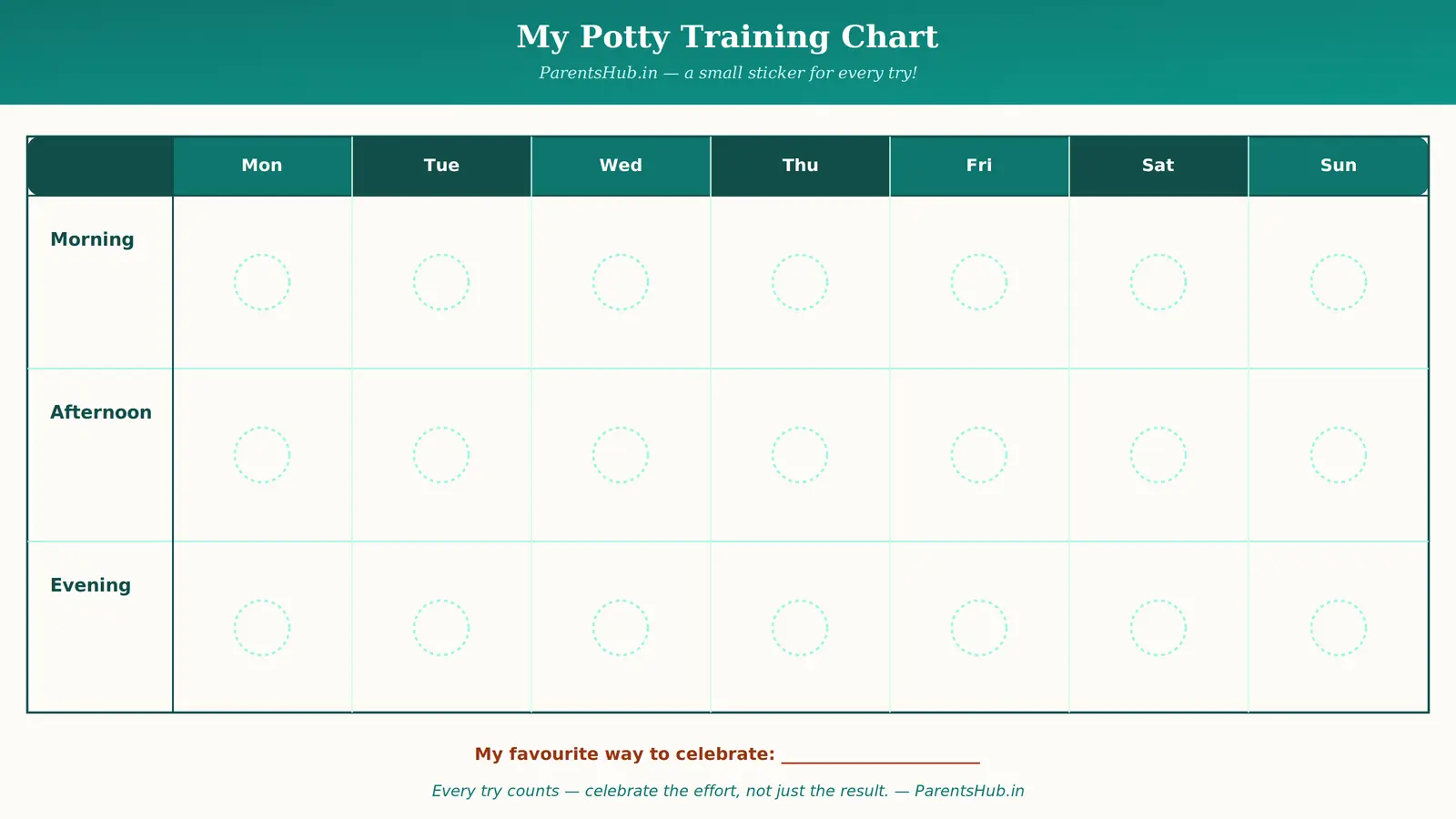
Download your free printable “My Potty Training Chart” – no email required
During the process of potty training a toddler, one thing to avoid is connecting rewards with punishment for accidents.
Pediatric guidance consistently recommends avoiding shame or punishment when accidents happen. These reactions can create anxiety around potty training and may slow down progress.
The goal is to encourage your toddler and help them learn—not make them afraid of getting it wrong.
When to See a Pediatrician About Potty Training
Most potty-training delays and difficulties are completely normal. Children develop at different speeds, and taking a little longer does not automatically mean that something is wrong.
However, there are some situations where it is worth speaking with your pediatrician:
- Your child is 4 years or older and shows no interest in or ability to start potty training.
- There is a sudden regression that lasts for more than a month without an obvious reason, such as a new sibling, moving house, or illness.
- Your toddler seems to be in pain while peeing or having a bowel movement.
- Your child has ongoing constipation or keeps holding in stool, and the problem is not improving.
- Your child has repeated urinary tract infections (UTIs), which can sometimes affect potty-training progress.
- Your child was previously dry during the day but suddenly loses that ability along with other developmental changes, such as losing words they previously used or showing reduced eye contact. In this situation, it is important to discuss the broader developmental changes with your pediatrician rather than looking at it only as a potty-training problem.
This is also in line with guidance from Indian digital-health platform Doctar. Its potty-training guidance highlights chronic constipation, recurrent UTIs, pain or fear around using the toilet, and a genuine lack of progress after several months of consistent effort as situations where parents should consider speaking with a pediatrician rather than continuing to troubleshoot the problem on their own.
This also connects with our Developmental Red Flags: 0–3 Years guide. If a potty-training delay is happening along with other developmental concerns, it is worth having a dedicated conversation with your pediatrician rather than treating toilet training as a separate issue.
Frequently Asked Questions
What is the typical age for a toddler to be potty trained?
Most toddlers show readiness between 18 and 24 months, with many fully daytime-trained between ages 2 and 3. Nighttime dryness often takes longer—sometimes until age 4 or later—which is completely normal.
Is it normal for a 3-year-old to not be potty trained yet?
es. Boys, on average, tend to complete potty training a little later than girls, although every child is different. It is worth discussing with your pediatrician if your child is 4 or older with no progress, or if there are other signs of concern.
While potty training a toddler, what is the 10-10-10 rule for potty training?
It generally refers to intensive potty-prompting methods, such as those inspired by Oh Crap Potty Training, where a parent takes the toddler to the potty every 10–20 minutes during a focused, at-home training period without diapers. The idea is to help the child quickly connect the sensation of needing to go with using the potty.
What is the quickest way to potty train a toddler?
Intensive methods such as the 3-day approach tend to work fastest, but they are best suited to toddlers showing strong readiness signs and require a caregiver to be consistently available for a few uninterrupted days. Consistency, more than speed, determines success.
How long does potty training regression last?
Most regressions resolve within a few weeks once the underlying trigger—such as a new sibling, daycare, illness, or travel—settles down, especially when parents respond calmly and patiently rather than adding pressure.
What gender is easier to potty train—boys or girls?
On average, girls tend to complete potty training somewhat earlier than boys. However, individual variation is large, so this should not be treated as a rule for any particular child.
Is age 3 too late to start potty training?
No. Many children begin around this age and potty train successfully. Some may even progress faster than toddlers who start earlier because their communication and body-awareness skills are more developed.
What is a red flag for potty training?
Persistent pain during urination or bowel movements, chronic constipation, sudden regression with no clear cause lasting more than a month, or a complete lack of interest or ability by age 4 are all reasonable reasons to speak with your pediatrician.
How do I potty train my toddler with an Indian-style (squat) toilet at home?
Start with a standalone potty chair or toilet seat adapter first, so your toddler can master the basic skill of recognising when they need to go and using the potty. You can introduce the squatting technique as a second stage once daytime potty training is established.
When should I worry if my child is not potty trained?
It is worth speaking with your pediatrician if your child reaches around age 4 with no progress at all, or earlier if there is pain, chronic constipation, recurrent UTIs, or regression along with other developmental changes. Before that, later potty training can simply be part of normal developmental variation.
What causes late potty training?
Most late starts come down to normal developmental pacing—some toddlers simply develop bladder and bowel awareness later than others. Less commonly, constipation, a stressful life change, or an underlying developmental or medical factor may play a role. Persistent delay past age 3–4 is worth discussing with your pediatrician.
What age is considered abnormal for a toddler to not be potty trained?
Most pediatric guidance does not treat a particular age below 4 as “abnormal” on its own because potty-training timelines vary considerably. If a child is past age 4 with no progress, it is reasonable to discuss whether a developmental or medical evaluation is needed.
Is it better to potty train every 15 or 30 minutes?
Neither interval is automatically “correct.” Frequent 10–20-minute prompts may suit an intensive, focused training period such as the 3-day method, while longer 30–45-minute intervals may work better with a gradual, routine-based approach built around meals, naps, and other parts of the day. Match the timing to your method and your toddler.
Can a 3-year-old be fully potty trained?
Yes. Many children complete daytime potty training by age 3, and some are dry at night by then too. However, nighttime dryness commonly takes longer and may extend into ages 4–5 even for children who are fully potty trained during the day.