
Learning how to handle toddler tantrums isn’t about stopping every meltdown. It’s about responding in ways that help your child learn emotional regulation. If you’re wondering how to handle toddler tantrums, you’re not alone. Almost every parent faces this challenge at some point. Let us imagine a scenario:
It’s 7 p.m. at a family wedding. Your two-year-old wants the last gulab jamun on the table. You say no — she’s already had two. Three seconds later she’s flat on the marble floor, screaming loud enough that half the hall turns to look.
You know that feeling. The hot flush of embarrassment. The urge to just hand over the sweet so it stops. And underneath it all, that familiar worry: log kya kahenge.

Take a breath. What’s happening on that floor isn’t bad parenting, and it isn’t a badly behaved child. It’s a two-year-old brain doing exactly what two-year-old brains do.
How to Handle Toddler Tantrums
This guide walks you through why tantrums happen, what to expect at each age, exactly what to say and do when one hits, and — because almost nobody covers this part — how to handle the pressures that come specifically with parenting in India: the relatives who hand over a biscuit before you’ve even reacted, the fear of being judged in public, and the meal timings that quietly make everything worse.
What’s Actually Happening Inside Their Head
Here’s a simple way to picture it. Your toddler’s brain has two departments. One handles big feelings — anger, disappointment, frustration. The other handles logic, patience, and self-control. In adults, these two talk to each other constantly, which is why you can feel furious in a meeting and still not throw your laptop across the room.
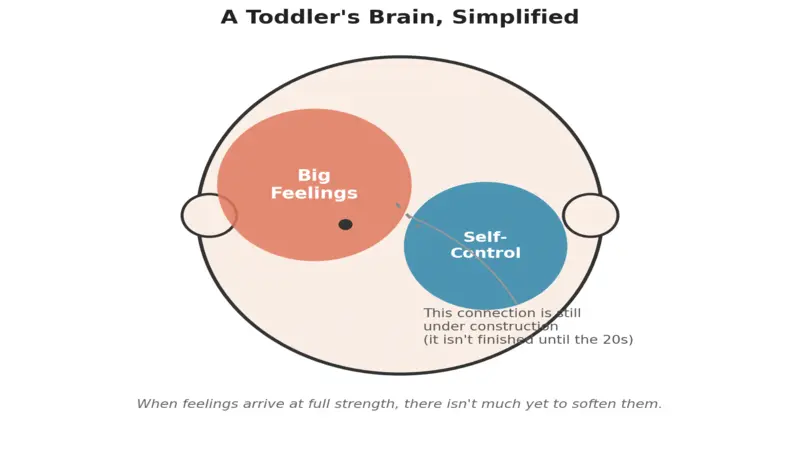
In toddlers, that connection barely exists yet. The wiring between “I feel something huge” and “I can manage how I react to it” doesn’t fully mature until well into a person’s twenties. So when you say no, the feeling arrives instantly, at full strength, with nothing built yet to soften it.
That’s not defiance. It’s not manipulation. It’s biology. Once you see it this way, staying calm gets a little easier — you’re not negotiating with a scheming three-year-old, you’re standing next to a brain that’s still being built.
Why Tantrums Actually Happen
Most of us oftern confront this reality in our daily lives and especially the parents. These tantrums are a part of the toddler almost everywhere. Most tantrums come down to one of these:
They’re hungry, tired, or overloaded
Ask any parent — a toddler who missed their nap is a completely different child by 5 p.m. Hunger and tiredness don’t cause tantrums directly, but they strip away whatever small amount of patience your toddler had to begin with.
They feel more than they can say
Try explaining “I’m upset because I wanted to press the lift button myself” when you don’t even have the word “myself” yet. That gap between the size of the feeling and the size of the vocabulary is where most tantrums are born.
They want control — and just lost it
Wanting to choose their own shirt, hold the spoon, or press the button themselves isn’t your toddler being difficult. It’s a two-year-old discovering, for the first time, that they have preferences. Losing that small battle can feel enormous to them.
The Indian meal-gap problem (nobody talks about this one)
Big breakfast, then a long stretch with nothing until a late lunch, then another gap before dinner — this pattern is common in a lot of Indian homes, and it quietly wrecks a toddler’s blood sugar. The result usually shows up as crankiness by mid-morning or a full meltdown by late afternoon. A small fix that works surprisingly fast: a snack around 10 a.m. and again around 4 p.m. Fruit, a few nuts, even a small katori of poha. Many parents notice fewer meltdowns within a week of adding this in.
Too many people, too much noise
A house full of relatives, loud conversation in three languages at once, unfamiliar cooking smells, a nap that got skipped because “the baby will sleep in the car”, and a stream of people wanting to pick him up or pinch his cheeks — for a toddler, that’s a lot to process in one afternoon. Indian family life brings this kind of sensory overload far more often than the average Western parenting article accounts for.
Tantrums by Age: What’s Normal
Tantrums don’t stay the same — they shift as your child grows. Here’s roughly what to expect.
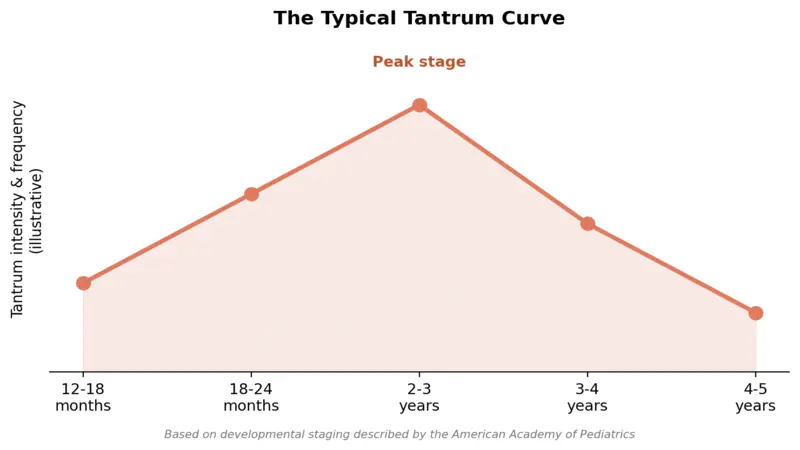
12 to 18 months
This is usually where it starts. Tantrums at this age are short and almost always tied to something physical — hungry, tired, uncomfortable — rather than a complicated emotion.
18 months to 2 years
Opinions are forming faster than the vocabulary to express them. This is where tantrums usually start showing up more often.
2 to 3 years — the peak
This is the classic “terrible twos” stretch. Nearly every toddler in this age range has at least one tantrum a day, lasting anywhere from a couple of minutes to fifteen. If this is where your child is right now, you are not doing anything wrong — you’re right on schedule.
3 to 4 years and beyond
Daily tantrums usually start thinning out here as language catches up. By around age four, most children have tantrums far less often. If big, frequent tantrums are still happening well past four or five, it’s worth a chat with your pediatrician — more on that later.
Not Every Meltdown Is the Same
Often we confuse the tantrums of baby as being a routine activity and tend to get annoyed by It, whenever the child resorts to such act. We kind of dismiss them at once and react to it instead of pondering over it. But this is not how to handle toddler tantrums from your end. Just being a little more thoughtful helps to notice which kind you’re dealing with:
- The “I didn’t get my way” tantrum — triggered by a denied request. Often has an audience — your child may glance over to check if you’re watching.
- The frustration tantrum — your toddler is trying to do something (stack the blocks, button the shirt) and can’t. This one usually isn’t for an audience.
- The meltdown — full sensory or emotional overload, often after a long outing or a broken routine. This isn’t about getting something — your child is genuinely overwhelmed and needs comfort, not a boundary.
Why does this matter? Because a “didn’t get my way” moment calls for a calm, held boundary — while a genuine meltdown calls for comfort first, everything else later.
What Indian Pediatric Experts Recommend
While many parenting articles rely on international guidance, UNICEF India has also developed practical recommendations with Indian child development experts. Their advice breaks a typical tantrum into three stages and suggests different ways parents can respond at each stage.
- Stage 1 — crying, yelling, whining: move your child to a calmer spot, distract them with something else, or offer a reasonable alternative to what they’re asking for.
- Stage 2 — falling to the ground, screaming, stamping: make sure the space is safe so they don’t hurt themselves, and step back from engaging with the attention-seeking part of it.
- Stage 3 — winding down, still whimpering: this is when physical comfort helps — a hug, soft words, staying close until they’re fully settled.
Cloudnine Hospitals, a large Indian maternity and child healthcare network, shares similar advice. They recommend staying with your child during a tantrum instead of walking away. Wait until your child has calmed down before talking about what happened, because children can’t think clearly when they’re overwhelmed. They also advise seeing your pediatrician if tantrums often involve self-harm, repeated head-banging, biting, hair-pulling, or other aggressive behaviour.
This advice is similar to recommendations from the American Academy of Pediatrics (AAP) and Johns Hopkins Medicine. The message is simple: stay calm, keep your child safe, acknowledge their feelings, and guide them with patience instead of punishment. It’s reassuring to know that both Indian and international child health experts recommend the same basic approach.
The Indian Academy of Pediatrics (IAP) also recommends a calm, consistent approach to handling tantrums. Their guidance encourages parents to stay calm, avoid giving in to tantrum-driven demands, redirect the child’s attention when appropriate, and never use physical punishment. These recommendations are based on established child development research and are widely accepted by pediatric experts.
Tantrums at Bedtime
Bedtime tantrums deserve their own mention — they’re one of the most searched tantrum scenarios, and they behave a little differently from daytime ones. By evening, your toddler is running on empty, and bedtime itself means stopping something fun (play) for something they may resist (sleep). That combination is a near-perfect tantrum setup.
- Start winding down 30–45 minutes before the actual bedtime — dim lights, quieter voices, no screens.
- Keep the sequence identical every night. Predictability itself is calming — bath, story, lights out, in the same order, every time.
- Offer a small choice inside the routine — “this book or that one?” — so bedtime doesn’t feel like something being done to them.
- Hold the line on delay tactics (one more story, one more sip of water) with a warm but firm “not tonight, we’ll do that tomorrow.”
When a New Baby Changes Everything
A tantrum spike after a new sibling arrives is one of the most common — and most misunderstood — patterns. Your toddler isn’t being difficult on purpose; they’re adjusting to sharing attention for the first time, often while also picking up on your own exhaustion at home.
- Protect a small window of one-on-one time daily, even 10–15 minutes, that’s entirely theirs.
- Involve them in small caregiving tasks — handing you a diaper, choosing the baby’s outfit — so they feel included rather than replaced.
- Expect some regression (wanting a bottle again, baby talk) and respond gently rather than correcting it — it usually passes on its own within a few weeks.
- Name what they might be feeling: “it’s hard sharing Mumma right now, isn’t it?” — without rushing to fix the feeling.
What To Do When It’s Actually Happening
Forget the idea of a perfect script. Here’s what actually works, in order.
- Stay calm first — your child is watching your face, not your words
Your toddler’s nervous system is reading yours. If you get loud or tense, it adds fuel. Take one breath before you respond. This one habit, more than any script, is what actually de-escalates a tantrum.
- Get down to their level, if it’s safe to
Kneeling down isn’t rewarding the tantrum. It just says, without words, “I’m here.”
- Say what they’re feeling before you hold the line
Naming the feeling isn’t the same as giving in. You can validate and still say no.
- Keep your words short
A toddler mid-meltdown can’t process a paragraph. Short, calm, repeated phrases beat any well-reasoned explanation.
- Let it run its course nearby
Most tantrums genuinely burn out within a few minutes once the peak has passed. You don’t need to fix it — you just need to be there.
A script you can actually use
| “You really wanted the mango. You’re upset we’re not buying it right now. I understand — that’s disappointing.” “We’re not buying sweets today. I’m going to stay right here with you until you feel better.” |
What Not To Do
- Don’t match their volume. Pediatric guidance is consistent on this: avoid yelling or hitting, since your child is learning how to handle big feelings by watching you handle yours.
- Don’t give in to make it stop. It works in the moment, but it teaches your toddler that a big enough tantrum eventually gets results — which makes the next one longer and louder.
- Don’t over-explain mid-meltdown. Save the reasoning for after they’ve calmed down. In the middle of it, they simply can’t take in your logic.
- Don’t label them. “You’re being naughty” or “good boys don’t cry” teaches a child to hide big feelings instead of learning to handle them — not what you actually want long-term.
Handling a Meltdown in Public
This is the one that causes Indian parents the most anxiety, so it gets its own section.
First, a reframe: every single parent in that market, mall, or ‘shaadi’ has either been through this with their own child, or will be soon. A toddler screaming on the floor says nothing about your parenting. It’s brain development happening in a public place, that’s all. The judgment you’re bracing for is almost always smaller than you think — and even when it’s real, it’s not worth changing your response over.

What actually helps:
- Move somewhere quieter if you can — a corner, just outside the shop, the car. Trying to manage a full meltdown in the middle of a crowd only makes it harder on both of you.
- Lower your voice instead of raising it. A quiet tone calms things down faster than a firm one — and it takes the “performance” out of a public tantrum.
- Resist buying the item just to end the scene. This is exactly the moment where giving in teaches the longest-lasting lesson — that public places are the best place to have a meltdown.
- Keep a short exit line ready — “we’re stepping outside for a minute” — and use it without apologising to every onlooker on your way out.
- Carry a small snack and water. A lot of public meltdowns line up exactly with a missed snack window.
When Grandparents Undercut You
You know this scene: your toddler starts crying, and before you’ve even had a chance to respond, a grandparent or relative has already handed over a biscuit, the phone, or a quick “okay okay, don’t cry.”
This usually isn’t about undermining you — it almost always comes from love, and from wanting to protect the child from any distress at all. But it does teach the exact pattern you’re trying to reduce: cry, get something, cry again next time.

A way to handle this without turning it into a fight:
- Talk to relatives before the gathering, not during it. “We’re helping him sit through frustration without a screen or a sweet — it would help a lot if you could back us up on this one” lands far better said quietly beforehand than corrected in the moment.
- Give grandparents something to do instead. “If he’s upset, could you just sit with him calmly instead of offering a biscuit? That actually helps him settle faster” gives them a role, rather than making them feel shut out.
- Pick your battles. One biscuit from a doting grandparent isn’t going to undo months of consistent parenting. Save your energy for the patterns that repeat the most.
- Present a united front with your spouse before raising it with the extended family, so it doesn’t land as one parent overruling the grandparents alone.
Heading Tantrums Off Before They Start
Prevention does more heavy lifting than anything you can say mid-tantrum, because a well-rested, well-fed toddler simply has fewer meltdowns to begin with.
| Trigger | What Helps |
| Skipped meals or long gaps | Add a 10 a.m. and 4 p.m. snack, even something small |
| Overtiredness | Protect nap time and an earlier bedtime, even during visits |
| Too much happening at once | Give a heads-up before transitions: “five more minutes, then we go” |
| Feeling out of control | Offer two acceptable choices instead of open-ended decisions |
| Boredom on long outings | Keep outings shorter than you think they need to be |
When Hitting or Aggression Is Part of the Tantrum
Biting, hitting, or throwing things during a tantrum needs a slightly different approach:
- Stop the action first, calmly. “I won’t let you hit me” — said firmly, without anger.
- Name it plainly. “Hitting hurts. I’m not going to let you hit.” No shame, just a clear line.
- Revisit it once they’re calm. “When you’re upset, you can stomp your feet or squeeze this cushion — but hands are not for hitting.”
- Repeat it consistently. This is a skill toddlers learn slowly, over months, not from one conversation.
A bit of hitting during tantrums at this age is common and, on its own, isn’t a red flag. If it’s frequent, getting worse, or aimed at a younger sibling in a way that worries you, mention it to your pediatrician.
When to Actually Worry
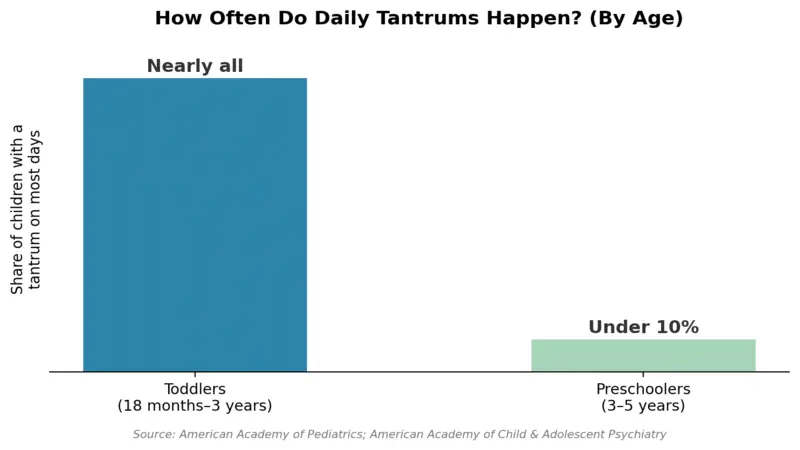
Most tantrums, however loud, are completely normal. Research on preschoolers found that more than 80% have at least one tantrum in a given month — but fewer than 10% have one every single day. So frequency alone usually isn’t the red flag people assume it is.
That said, it’s worth talking to your pediatrician if tantrums are getting more severe, lasting a long time, happening many times a day, or still showing up regularly in a child older than five. Reach out sooner if your child is hurting themselves or others, breaking things, holding their breath, or showing signs of headaches, stomachaches, or anxiety alongside the tantrums.
And if you’re the one feeling constantly stressed, frustrated, or unsure how to cope — that’s worth mentioning to your pediatrician too. Support exists for parents, not just children.
And if you’re the one feeling constantly stressed, frustrated, or unsure how to cope, that’s worth discussing with your pediatrician too. Parenting a toddler can be challenging, and seeking support is a sign of strength—not failure.
Knowing how to handle toddler tantrums takes patience and practice, but these strategies become easier with time.
Frequently Asked Questions
At what age do tantrums peak?
Between 2 and 3 years — this is the classic “terrible twos” stretch, before things ease off as language catches up.
At what age do tantrums usually stop?
Most children see a big drop by around age four, though the occasional tantrum can stick around in a milder form for a while after.
What actually triggers tantrums in toddlers?
Hunger, tiredness, sensory overload, a vocabulary that can’t keep up with big feelings, and a blocked sense of control. In Indian households, meal-timing gaps and crowded family gatherings are two triggers that rarely get mentioned elsewhere.
What should you avoid doing during a tantrum?
Yelling, spanking, giving in just to stop the noise, and trying to reason with a child mid-meltdown — none of these help in the moment.
How long should you “ignore” a tantrum?
The idea isn’t to walk away — it’s to stay calm and physically present while not reacting to the tantrum itself. Your attention is one of the strongest tools you have, so save it for after things calm down.
How many tantrums a day is normal?
For toddlers between 18 months and 3 years, at least one a day is genuinely typical — not a sign anything is wrong.
What are signs of a tantrum that isn’t typical?
Unusual severity, very long duration, many episodes a day, self-injury or harm to others, or tantrums that persist regularly past age five — these are worth a conversation with your pediatrician.
Can too much screen time cause more tantrums?
It can contribute, mainly by disrupting sleep and replacing the face-to-face interaction toddlers need to build emotional regulation. The Indian Academy of Pediatrics recommends no screen time at all under age two, and strictly limited, supervised screen time between two and five.
Is a tantrum ever linked to autism?
An occasional tantrum, on its own, isn’t a sign of autism. But if tantrums are unusually frequent or intense, and appear alongside limited eye contact, delayed speech, or real difficulty with everyday changes in routine, it’s worth raising with your pediatrician — not to worry you, but because early support tends to help the most.
How to handle toddler tantrums without yelling?
The best way to handle toddler tantrums is to stay calm, acknowledge your child’s feelings, and avoid shouting or giving in to unreasonable demands. Once your child has calmed down, talk about what happened and guide them toward better ways to express their emotions.
How to handle toddler tantrums in public?
Handling toddler tantrums in public starts with staying calm and ensuring your child’s safety. If possible, move to a quieter place, avoid arguing or negotiating during the tantrum, and wait until your child has settled before discussing what happened. Consistency at home and in public helps children learn appropriate behaviour.
How to handle toddler tantrums at bedtime?
Bedtime tantrums are often triggered by tiredness, overstimulation, or changes in routine. A predictable bedtime routine, limited screen time before bed, and a calm response from parents can reduce these emotional outbursts over time.
This article is for general information and isn’t a substitute for advice from your child’s doctor. If you’re worried about your child’s development or behaviour, please talk to your pediatrician.
References
- Cloudnine Hospitals – Temper Tantrums in Kids: Ways to Deal With Them
- Indian Academy of Pediatrics (IAP) – Temper Tantrums (Chapter 145)
- American Academy of Pediatrics (AAP) – Temper Tantrums: What Parents Need to Know
- Johns Hopkins Medicine – When to Worry About Toddler Temper Tantrums
- UNICEF India – Handling Temper Tantrums