
Your baby is nine months old and still not sitting without support. Or your toddler is two and says only a few words. A neighbour says, “He will talk when he is ready.” A relative agrees. But a small voice inside you keeps asking: is this normal?
This guide explains Developmental Red Flags 0 to 3 Years for children in plain words. You will see what doctors mean by the term, which skills to look for at each age, how to tell one missed skill from a real pattern, and where to go in India for a proper check. A red flag is a reason to look closer. It is not a diagnosis. And looking closer early is almost always better than waiting and wondering.
Recognising developmental red flags 0 to 3 years early can help parents seek appropriate guidance when a child’s development raises concerns.
A developmental red flag is a sign that a child’s development needs a closer look by a doctor. The most important ones are losing a skill the child already had, not reacting to sounds or people, and not reaching several milestones by the age most children reach them. One late skill is not a diagnosis. If you are worried, talk to your paediatrician and ask for a developmental screening.
Milestone, red flag, delay: what is the difference?
These words are often mixed up online, which causes needless fear. Here is how doctors use them.
|
Term |
What it means |
Example |
|---|---|---|
|
Milestone |
A skill most children show by a certain age. The US Centers for Disease Control and Prevention (CDC), a public-health agency, counts a skill as a milestone when 75% or more of children can do it by that age. |
Walks without holding on by 18 months. |
|
Red flag |
A sign that deserves a closer look. It is a prompt to ask, not an answer. |
Not reacting to loud sounds, or losing words. |
|
Developmental delay |
A child takes longer than expected to learn skills in one or more areas. Global developmental delay means delay in two or more areas. |
Late sitting and late speech together. |
|
Diagnosis |
A specific condition named by a qualified specialist after assessment. No checklist, app or article can do this. |
– |
Two more words will help you at the clinic.
Surveillance means your doctor watches and asks about development at every visit.
Screening means a short, structured tool used at set ages, such as 9 and 18 months. Screening is more reliable than a casual “is he doing okay?”
Why do different websites show different ages?
In 2022 the CDC and the American Academy of Pediatrics (AAP) revised their milestone checklists. Older lists showed the age by which about half of children had a skill. The new lists use the age by which 75% or more do, to reduce “wait and see”. Older books and apps may still show earlier ages. The tables below follow the current CDC checklists, in simple English.
These lists come from the United States, and the CDC itself says they are not a substitute for a validated screening tool. The Indian Academy of Pediatrics (IAP) 2020 consensus statement backs the same approach: watch for red flags at every routine visit and screen with a standard tool at set ages.
Red flags at any age
Some signs matter at every age, from the first month to the third birthday:
- Losing a skill your child once had, such as babbling, words, waving, smiling or walking.
- Not reacting to loud sounds or to your voice.
- Little interest in faces: rarely looking at you, rarely smiling back, not following you with the eyes.
- A worry that keeps coming back. You see your child every day, and your instinct counts.
“Acting early can significantly improve outcomes and help your child reach their full potential.”
Consultant Paediatric Neurologist, Manipal Hospitals, Yeshwanthpur, Bengaluru
Losing a skill is the one sign every major framework treats seriously. Do not wait for the next vaccination visit. Call your paediatrician soon and say it plainly: “My child used to do this, and now does not.”
Manipal’s paediatric neurology guidance also lists stiff or floppy muscles and feeding trouble in infants. Lists differ a little between sources, so treat them as conversation prompts, not a pass-or-fail test.
Developmental Red Flags 0 to 3 Years: Warning Signs by Age
Each table shows what most children are doing in that age band. If your child is doing most of these, relax and enjoy. If several are missing, or a skill has been lost, speak to your paediatrician. If your baby was born early, use the corrected age until 24 months, as the IAP advises. For example, an 8-month-old born two months early should be checked against the 6-month list.
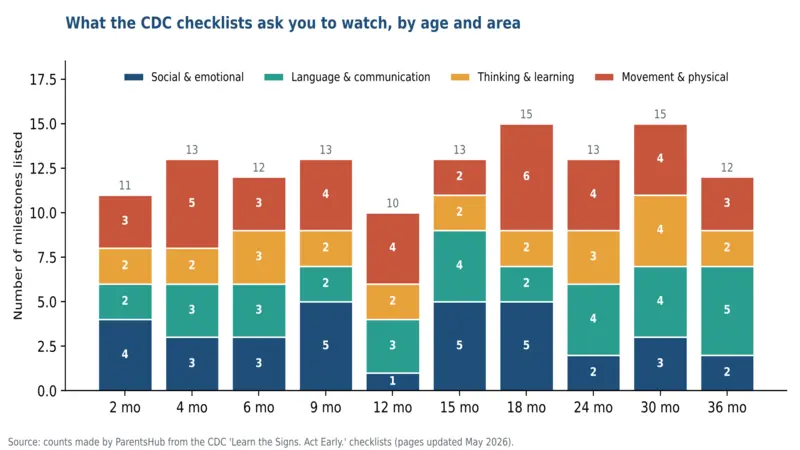
Birth to 3 months (CDC 2-month checklist)
| Area | Skills to look for |
|---|---|
| Social and emotional | Calms when spoken to or picked up. Looks at your face. Smiles when you smile or talk. |
| Language | Makes sounds other than crying. Reacts to loud sounds. |
| Thinking | Watches you as you move. Looks at a toy for a few seconds. |
| Movement | Lifts head on tummy. Moves both arms and legs. Opens hands briefly. |
By around 2 months, many babies begin smiling in response to others, watching faces and making sounds other than crying. They should also react to loud sounds, move both arms and legs, and briefly lift their head during tummy time. If your baby does not respond to sounds or have difficulty following your face with their eyes, discuss this with your paediatrician and ask whether hearing and vision checks are needed. You can also confirm whether your baby had the newborn hearing screening.
4 to 6 months (CDC 4- and 6-month checklists)
| Area | Skills to look for |
|---|---|
| Social and emotional | Smiles on their own to get your attention. Chuckles. Knows familiar people. Laughs. Likes looking in a mirror. |
| Language | Coos and makes sounds back to you. Turns towards your voice. Takes turns making sounds. Blows “raspberries” and squeals. |
| Thinking | Looks at own hands. Opens mouth when they see the breast or bottle. Reaches for a toy. Puts things in the mouth to explore. |
| Movement | Holds head steady. Pushes up on elbows when on tummy. Rolls from tummy to back. Leans on hands when sitting. |
Between 4 and 6 months, babies gradually become more interactive and curious about their surroundings. They may turn towards your voice, take turns making sounds, reach for toys, and explore objects by putting them in their mouths. They also develop better head control, push up on their elbows during tummy time, and begin rolling from tummy to back. If your baby is not making progress in these areas or you have concerns about their hearing, movement, or interaction, discuss them with your paediatrician.
7 to 9 months (CDC 9-month checklist)
| Area | Skills to look for |
|---|---|
| Social and emotional | Is shy or clingy with strangers. Looks when you call their name. Reacts when you leave. Smiles at peek-a-boo. |
| Language | Makes sounds like “mamama” and “bababa”. Lifts arms to be picked up. |
| Thinking | Looks for a toy that dropped out of sight. Bangs two things together. |
| Movement | Sits without support and gets into sitting alone. Passes a toy from hand to hand. Rakes food towards self with fingers. |
Between 7 and 9 months, babies become more responsive to familiar people and their surroundings. They may look when you call their name, enjoy games such as peek-a-boo, and raise their arms to be picked up. They also begin looking for dropped toys, passing objects between their hands, and sitting without support. The 9-month visit is a good opportunity to discuss your baby’s development with your paediatrician, as both the American Academy of Pediatrics (AAP) and the Indian Academy of Pediatrics (IAP) recommend developmental screening at this age.
10 to 12 months (CDC 12-month checklist)
| Area | Skills to look for |
|---|---|
| Social and emotional | Plays games like pat-a-cake. |
| Language | Waves bye-bye. Calls a parent “mama”, “dada” or a special name. Pauses when you say “no”. |
| Thinking | Puts a block in a cup. Looks for a toy they saw you hide. |
| Movement | Pulls up to stand. Walks holding furniture. Drinks from an open cup with your help. Picks up small food with thumb and finger. |
Between 10 and 12 months, babies begin using gestures and simple actions to communicate with others. They may wave goodbye, respond to “no,” use a special name for a parent, and enjoy simple games such as pat-a-cake. They also begin looking for hidden toys, putting objects into containers, pulling themselves up to stand, and walking while holding furniture. If your baby is not showing progress in these skills or you have concerns about their development, discuss them with your paediatrician.
13 to 18 months (CDC 15- and 18-month checklists)
| Area | Skills to look for |
|---|---|
| Social and emotional | Shows you things they like. Claps. Shows affection. Points to show you something interesting (18 months). Looks at book pages with you. |
| Language | Tries one or two words besides “mama” and “dada” (15 months). Points to ask for things. Tries three or more words and follows a one-step instruction without gestures (18 months). |
| Thinking | Uses everyday things the right way, like a cup or phone. Stacks two blocks. Copies chores. Plays simply with toys. |
| Movement | Takes a few steps alone (15 months). Walks without holding on (18 months). Scribbles. Tries a spoon. Climbs on and off a sofa. |
Between 13 and 18 months, children become more independent in how they move, communicate and explore. They may point to show you something interesting, show affection, copy everyday activities, use a spoon, and begin scribbling. Many take a few independent steps by 15 months and walk without holding on by 18 months. If your child is not walking independently by 18 months, speak to your paediatrician rather than waiting until the second birthday. Also mention any concerns about speech, interaction or other developmental skills.
19 to 24 months (CDC 24-month checklist)
| Area | Skills to look for |
|---|---|
| Social and emotional | Notices when others are hurt or upset. Looks at your face to see how to react in a new situation. |
| Language | Points to pictures in a book when asked. Says at least two words together, like “more milk”. Points to two body parts. Uses gestures like blowing a kiss or nodding. |
| Thinking | Uses buttons or knobs on a toy. Plays with more than one toy at once. Holds something in one hand while the other hand works. |
| Movement | Kicks a ball. Runs. Walks up a few stairs. Eats with a spoon. |
By 2 years, most children can point to pictures in a book when asked, point to at least two body parts, and say at least two words together, such as “more milk.” They also begin using gestures such as blowing a kiss or nodding, noticing when others are upset, running, kicking a ball, and walking up a few stairs. If your child is not walking independently, is not combining at least two words, or is missing other milestones, speak with your paediatrician and ask about developmental screening. If you have concerns, do not wait for the next routine visit.
25 to 36 months (CDC 30-month and 3-year checklists)
| Area | Skills to look for |
|---|---|
| Social and emotional | Plays next to other children and sometimes with them. Says “Look at me!” Follows routines like clean-up time. Joins other children’s play (3 years). Calms within 10 minutes after you leave (3 years). |
| Language | About 50 words and two or more words together (30 months). Names things in a book. Says “I”, “me” or “we”. Chats back and forth, asks “who, what, where, why”, says own first name, and is understood most of the time (3 years). |
| Thinking | Pretend play. Simple problem-solving, like climbing a stool. Follows two-step instructions. Knows one colour. Draws a circle when shown. Avoids hot things when warned. |
| Movement | Twists lids or doorknobs. Takes off some clothes. Jumps with both feet. Turns book pages. Strings large beads. Puts on some clothes. Uses a fork. |
Between 2½ and 3 years, children make progress in language, social interaction, thinking and everyday physical skills. By 30 months, most children use around 50 words and combine two or more words, such as “more milk.” By 3 years, many can take part in simple back-and-forth conversations, ask questions such as “who,” “what,” “where” or “why,” say their first name, and join other children’s play.
If your child uses far fewer words than expected, is not combining words by 30 months, or you have concerns about their interaction or other developmental skills, speak with your paediatrician and ask about developmental screening and a hearing check. Tantrums are common in toddlers, but persistent concerns about communication or social interaction deserve attention rather than being dismissed as behaviour alone.
One missed sign or a pattern?
This is the question behind most searches. The CDC’s rule is simple: if your child is not meeting one or more milestones, has lost skills, or you have any concern, talk to the doctor and ask about screening. That is a prompt to look closer, not a verdict. What worries doctors more is delay across more than one area, or a skill that has been lost.
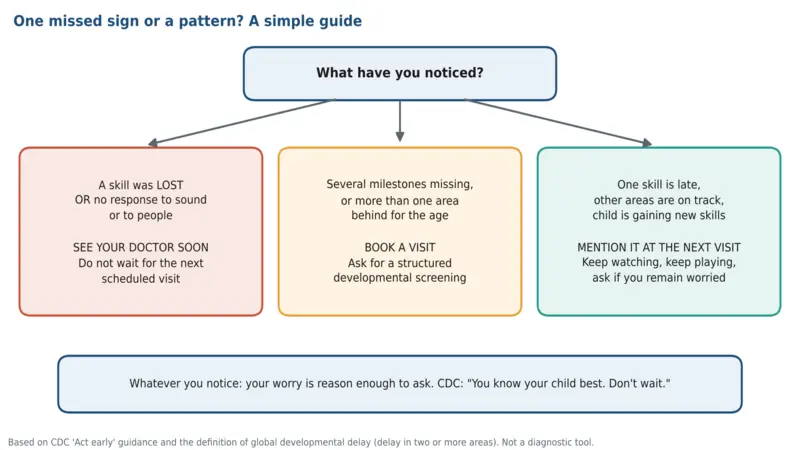
| What you see | What it usually calls for |
| One skill is late, other areas are on track, and new skills keep arriving | Mention it at the next visit. Keep playing, talking and watching. |
| A milestone is not met at its age, or your worry keeps returning | Book a visit within a few weeks. Ask for a structured screening. |
| Delay in two or more areas, or several missed milestones over time | See your paediatrician soon. This is how a doctor decides whether a fuller assessment is needed. |
| Lost skill, or no reaction to sounds or people | See a doctor soon. Do not wait for the next routine visit. |
The CDC checklists are useful starting points, but they should not be treated as the only reason to seek help. If you are concerned about your child’s development, speak with your paediatrician rather than waiting for a checklist age or for concerns to become more pronounced.
The “red flags” age grid many clinicians use comes from Queensland Health in Australia, and its own guide says it is a professional resource, not a screening tool. So this article takes the idea from it, and the facts from the CDC and IAP.
Why do developmental delays happen?
There is rarely one simple answer, and sometimes no single cause is found. Common possibilities include:
- Hearing or vision problems. A child who cannot hear well may look “slow” in speech and play. This is one of the first things to rule out.
- Early birth or a difficult start. MS Ramaiah Memorial Hospital lists premature babies, low birth weight, birth complications and NICU stays as higher-risk groups needing closer follow-up.
- Nutrition. The IAP 2020 statement identifies four risk factors for poor child development: stunting, low stimulation, iodine deficiency and iron-deficiency anaemia. In India, nutritional deficiencies remain an important public-health concern. NFHS-5 (2019–21) found that 67.1% of children aged 6–59 months were anaemic. This highlights the importance of addressing nutritional health as part of a child’s overall development.
- Too little talk and play. Low stimulation is also an IAP risk factor. This is not blame. Busy homes compete for attention, and small daily changes help.
- Neurodevelopmental conditions, such as autism or cerebral palsy. Only a qualified specialist can assess these.
Can vitamin deficiency cause speech delay?
Nutritional deficiencies can affect a child’s growth, brain development and overall health. Certain nutrients, including iron, iodine, vitamin B12 and folate, play important roles in early brain development. A significant deficiency may contribute to developmental difficulties, but it is not possible to assume that a child’s speech delay is caused by a lack of vitamins or minerals.
Speech and language delays can have several causes, including hearing difficulties, differences in language development and broader developmental conditions. This is why it is important to look at your child’s overall communication and development rather than focusing on nutrition alone.
If your child is speaking fewer words than expected, is not combining words at the expected age, or has stopped using words they previously used, consult your paediatrician. Depending on your child’s history and symptoms, the doctor may recommend a hearing assessment, developmental screening or specific blood tests to check for nutritional deficiencies.
Offer a varied, age-appropriate diet, but do not start high-dose vitamin or mineral supplements without medical advice. Most importantly, do not delay a speech and language assessment while trying dietary changes or supplements.
What to Do About Developmental Red Flags 0 to 3 Years: Where to Go in India
Step 1: Talk to your paediatrician and ask for screening
A useful line to say: “Can we do a structured developmental screening for my child?” Casual questions at check-ups are common, so it is fair to ask for a structured tool. Here are the two recommended schedules side by side.
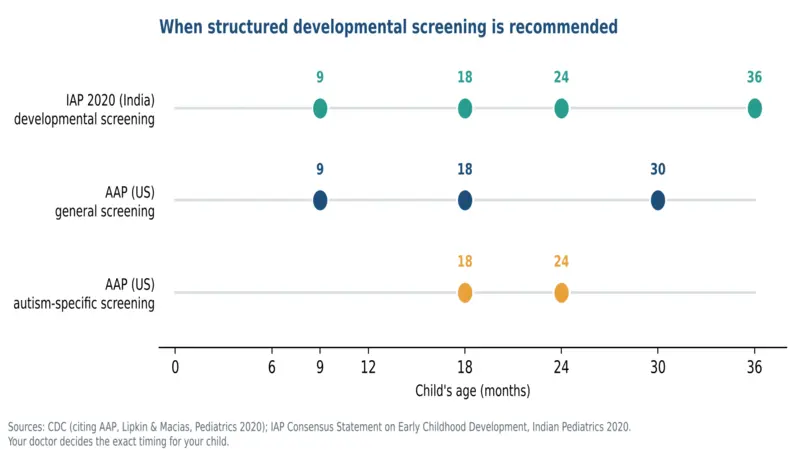
| Schedule | General screening | Autism-specific screening |
| AAP / CDC (United States) | 9, 18 and 30 months | 18 and 24 months |
| IAP 2020 (India) | 9, 18, 24 and 36 months | Not shown separately in this summary |
Step 2: Know the government route
India has a public pathway for young children, but few parenting pages explain it. Under the Rashtriya Bal Swasthya Karyakram (RBSK), children from birth to 18 years are screened for the “4 Ds”: defects at birth, deficiencies, diseases and developmental delays including disability.
Mobile health teams screen children at Anganwadi centres from 6 weeks to 6 years. Children found to need help may be referred to a District Early Intervention Centre (DEIC), which supports children up to 6 years.
DEIC guidelines describe early-intervention services for eligible children, including therapy for certain developmental and neuro-motor concerns. Services and referral processes may differ locally, so contact your district DEIC or ask your Anganwadi worker, ASHA or district hospital about options in your area.
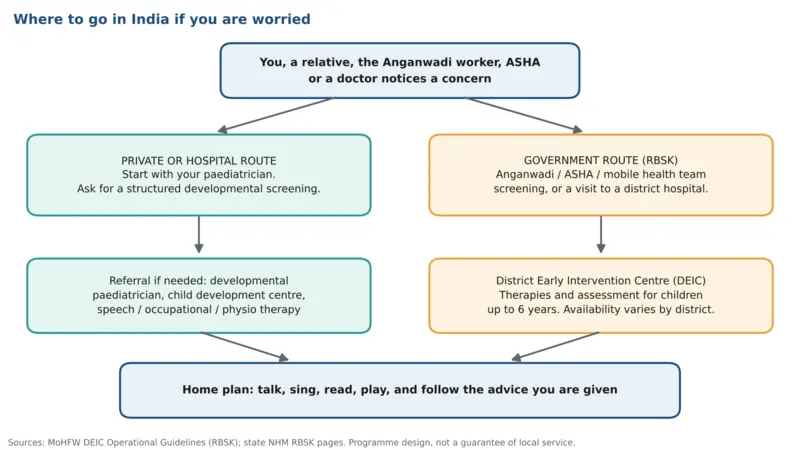
Be realistic: this is how the programme is designed. Services available locally and waiting times can vary by district, so ask your Anganwadi worker, ASHA or district hospital about the options in your area.
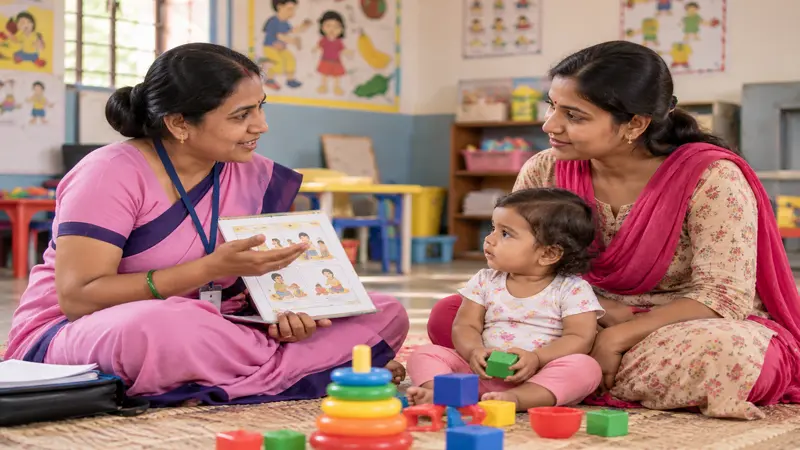
Step 3: Prepare for the visit
- Write down what your child can do and what worries you.
- Note any lost skills and when you noticed them.
- Mention premature birth, NICU stay or other health needs.
- Take a short phone video of the behaviour that worries you.
Step 4: Keep playing at home
While you wait, do what helps every child: talk through the day, sing, read picture books, play peek-a-boo and answer every babble. The IAP encourages the mother tongue in daily care, so there is no need to switch languages out of worry. For tracking, the IAP statement suggested the CDC Milestone Tracker app until an Indian app exists; check that it is still current.
Dealing with “wait and see” at home
Grandparents and relatives are usually kind and well-meaning. They have seen late talkers who turned out fine, and that is true for some children. But it is a guess, not a check. The CDC puts “Don’t wait” on every age page for a reason.
You can keep the peace and still act. Try: “You may well be right. We are just getting a quick check so we can all relax.”
And this is not your fault. Asking early is not overreacting. It is good parenting.
When to See a Doctor About Developmental Red Flags 0 to 3 Years
See your paediatrician soon if your child:
- has lost a skill such as babbling, words, smiling or walking.
- does not react to loud sounds or to your voice
- is not meeting several milestones for their age, or is behind in two or more areas
- is not walking by 18 months or not joining two words by 2 years
- was born early or had a NICU stay and seems to be falling behind.
or you simply have a worry that will not go away
If these concerns appear alongside other developmental worries, discuss the whole picture with your paediatrician rather than treating each one alone. Recognising developmental red flags 0 to 3 years early can help parents seek timely advice and appropriate support.
Frequently asked questions
What are some common developmental red flags in children?
Losing a skill, not reacting to sounds or people, and not reaching several milestones for the age. Examples are no babbling by 9 months, no steps alone by 18 months, and no two-word phrases by 2 years. One late skill alone is not a diagnosis.
Is developmental delay serious?
A delay is a reason to check, not a diagnosis. Some children need a little extra support, others longer-term help. Only an assessment can tell.
What is global developmental delay?
It means delay in two or more areas of development, such as movement and speech together. It is a descriptive term, not a cause.
What is the most common cause of developmental delay?
No single cause fits every child. Hearing problems, premature birth, nutrition, low stimulation and neurodevelopmental conditions are all possibilities. Sometimes no cause is found.
Can a child recover from developmental delay?
It depends on the cause and the areas affected. Many children make good progress with support, and early help gives the best chance. No one can promise how far a particular child will go.
What is the best treatment for developmental delay?
There is no single treatment. Support depends on the child’s needs and may include speech therapy, occupational therapy, physiotherapy or special education. At a DEIC, therapies are offered to children up to 6 years.
Are autistic babies late to crawl?
Crawling is not included in the CDC milestone checklists, and babies may move in different ways before walking. Crawling age alone cannot indicate whether a baby is autistic. Autism assessment considers broader patterns of social communication, interaction and behaviour. If you have concerns about your baby’s development, discuss them with your paediatrician.
Do autistic babies meet their milestones?
Some autistic children meet many early developmental milestones, while others show delays in areas such as communication or social interaction. One missed milestone does not mean a child is autistic. If your child is missing several milestones, shows developmental concerns or loses a skill they previously had, speak with your paediatrician. The American Academy of Pediatrics recommends autism-specific screening at 18 and 24 months.
How can I improve speech delay in a 3-year-old?
Start with a hearing check and an assessment by your paediatrician or a speech-language therapist. At home, talk, read and sing daily. Apps are no substitute for a professional assessment.
Which doctor should I see first?
Your regular paediatrician. They can screen your child and refer you to a developmental paediatrician, neurologist or therapist.
Can the Anganwadi worker or ASHA help?
Yes, as a first contact. Mobile health teams under RBSK screen children at Anganwadi centres, and they can refer you to a DEIC. Services differ by district.
Every child grows at their own pace. But you know your child best. If something feels different, ask early, ask calmly, and keep playing together.
How late is too late for a toddler to walk?
The CDC says most children (75% or more) walk without holding on by 18 months. A few steps alone is a 15-month milestone. If your child is not walking by 18 months, speak to your doctor then. Do not wait until the second birthday
My 2-year-old is not walking or talking yet. What should I do?
Two areas behind at once is exactly the pattern doctors want to hear about. Book a visit soon, ask for a structured screening and a hearing check.
Is a 2-year-old a late talker?
Some are, but the CDC looks for two words joined together by this age. Manipal’s guidance also lists few or no meaningful words by 2 years as a reason for assessment.
Is it normal for a 2½-year-old not to talk?
By 30 months the CDC expects about 50 words and some two-word joining. If your child uses far fewer, do not wait for the third birthday. Ask for a hearing check and a screening now.
Is my 3-year-old’s behaviour a red flag or just tantrums?
Tantrums are common in toddlers and usually shorten as children grow (see [Internal link: How to Handle Toddler Tantrums (Without Losing Your Mind)]). Manipal’s list mentions poor eye contact, little interaction with others and strong sensitivity to sounds, textures or routines. If these appear together with delayed talking, talk to your doctor.
This article provides general information for parents. It is not medical advice and cannot diagnose any condition. Always consult your paediatrician about your child’s health and development.
References:
Indian Pediatrics. Developmental Delay Review. May 2010;47:415–422. https://indianpediatrics.net/may2010/may-415-422.htm
Centers for Disease Control and Prevention (CDC). Learn the Signs. Act Early.: Developmental Milestones. Milestone checklists by age. https://www.cdc.gov/act-early/milestones/
Centers for Disease Control and Prevention (CDC). Developmental Monitoring and Screening. https://www.cdc.gov/act-early/about/developmental-monitoring-and-screening.html
Bharadva K, et al. Consensus Statement of the Indian Academy of Pediatrics on Early Childhood Development. Indian Pediatrics. Published online May 22, 2020. https://indianpediatrics.net/epub052020/RECOMM-00185.pdf
Ministry of Health and Family Welfare, Government of India. Operational Guidelines: District Early Intervention Centres under RBSK. https://nhm.hp.gov.in/storage/app/media/uploaded-files/GoI%20DEIC%20guidelines.pdf
National Health Mission, Goa. Rashtriya Bal Swasthya Karyakram (RBSK). https://nhm.goa.gov.in/rbsk/
Additional state reference: National Health Mission, Uttar Pradesh. RBSK. https://upnrhm.gov.in/Home/Rbsk
Dr Deepthi K. Red Flags in Child Development. Manipal Hospitals, Yeshwanthpur, Bengaluru. Reviewed February 27, 2026. https://www.manipalhospitals.com/yeshwanthpur/blog/red-flags-in-child-development/
MS Ramaiah Memorial Hospital. Development Delay in Children. Hospital blog, 2023. https://msrmh.com/?p=2558
Queensland Children’s Health Services. Red Flags Early Identification Guide. Updated September 2024. https://www.childrens.health.qld.gov.au/wp-content/uploads/PDF/red-flags.pdf
Ministry of Health and Family Welfare, Government of India. India’s Fight Against Anemia. Press Information Bureau, April 18, 2025. https://www.pib.gov.in/PressReleasePage.aspx?PRID=2122623&lang=2®=48